Premature coating failure is often blamed on the powder itself. When an industrial component begins to peel, blister, corrode, or show inconsistent finish quality, changing the coating chemistry may seem like the obvious response. In many cases, however, the real problem started before the powder reached the metal.
Effective surface preparation services establish the conditions required for coating adhesion, corrosion protection, and consistent performance. Industrial steel, fabricated assemblies, energy infrastructure, marine components, and heavy equipment and machinery can arrive with rust, mill scale, grease, fabrication residue, old coatings, or other contaminants. If these conditions are not properly addressed, even a high-performance coating system can fail prematurely.
For industrial buyers, identifying preparation problems early can prevent repeated coating failures, unnecessary refurbishment, and shortened asset life. The following seven warning signs can indicate that components are being underprepared before finishing.
1. Visible Flash Rust Appears Before Coating
Freshly prepared steel is highly reactive. Once rust, scale, and other surface materials have been removed, exposure to moisture can begin oxidation quickly.
Flash rust appearing before coating application is therefore a significant warning sign.
It can indicate that too much time is passing between blasting and coating, that environmental conditions are not being adequately controlled, or that the prepared surface is being exposed to moisture before application.
This becomes particularly important for marine shipyard components and industrial assets operating in humid or corrosive environments. Chlorides, humidity, and moisture can accelerate corrosion and compromise the surface before the protective system is established. Professional Powder Coating’s existing technical guidance emphasizes that coastal conditions can increase flash rust risk following blasting and that preparation and coating schedules should be coordinated accordingly.
Industrial buyers should ask how long prepared components remain exposed before coating and what controls protect freshly blasted steel.
A properly managed preparation process should treat blasting and coating as connected production stages, not unrelated services.
2. Gloss or Texture Varies Across the Same Production Batch
Visual inconsistency across a production run is not always caused by the powder.
If components coated with the same material under nominally identical conditions show noticeable differences in texture or appearance, inconsistent substrate conditions may be contributing to the problem.
Surface roughness, residual contamination, pretreatment quality, coating thickness, and cure conditions can all influence the final result.
This becomes particularly concerning on large industrial orders. A supplier may successfully finish a small sample while struggling to maintain the same preparation conditions across hundreds of components.
Consistent metal cleaning and coating requires repeatable process control from the first component through the final batch.
Industrial buyers should therefore investigate whether preparation procedures are standardized and whether the supplier verifies substrate condition before application.
Automatic coating systems can improve application consistency for appropriate production runs, but automation cannot compensate for poorly prepared substrates. The condition entering the coating stage still matters.
3. Adhesion Failure Starts at Welds, Edges, or Fasteners
Edges, welds, corners, fastener areas, and complex geometries are often where weaknesses become visible first.
These locations can retain contamination or receive inconsistent preparation. They can also present more challenging conditions for coating coverage and film build.
If peeling, corrosion, or delamination repeatedly begins around welds or edges, the problem deserves closer investigation.
A coating system depends on a stable interface with the substrate. Rust, fabrication residue, oil, scale, or inadequate surface profiling can reduce adhesion at precisely the locations already exposed to mechanical and environmental stress.
Professional Powder Coating’s previous technical material identifies inconsistent film build around edges, weld seams, and corners as a potential source of vulnerable protection zones.
Preparation therefore needs to account for the component’s full geometry rather than focusing only on broad, accessible surfaces.
For industrial assets exposed to moisture, chemicals, abrasion, or outdoor conditions, small preparation deficiencies can become corrosion initiation points that eventually spread beneath the coating.
4. The Vendor Has No Documented Pretreatment Step
One of the clearest warning signs is an inability to explain what happens between receiving the component and applying the finish.
Industrial buyers should be able to ask a vendor:
What is your pretreatment process for this substrate and coating specification?
The answer should be specific.
The appropriate preparation method depends on the substrate, existing condition, coating system, exposure environment, and project requirements. Depending on the application, preparation can include abrasive blasting, mechanical cleaning, chemical cleaning, stripping, surface profiling, or other specified pretreatment processes.
A vague statement such as “we clean everything before coating” provides little evidence of process control.
The issue is particularly important when comparing powder coating with industrial painting service pre-treatments. Different finishing systems can require different preparation strategies, but neither should rely on an inadequately cleaned substrate.
Industrial procurement teams should look for a defined process rather than a generic cleaning claim.
Documentation also improves repeatability. If the same component returns six months later for another production run, a documented process provides a basis for reproducing the preparation conditions rather than relying on operator memory.
5. The Blasting Profile Is Not Matched to the Substrate or Coating System
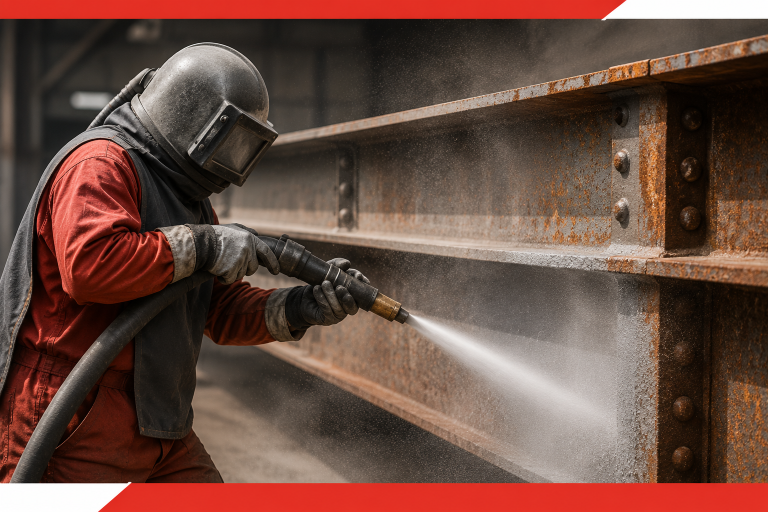
Abrasive blasting does more than remove visible corrosion. It can also establish an anchor profile that supports mechanical adhesion between the substrate and the protective coating.
However, more aggressive blasting is not automatically better.
The required profile should correspond to the substrate and coating specification. An insufficient profile may not provide the required mechanical bond. An inappropriate profile for the coating system can create its own application challenges.
Professional Powder Coating emphasizes SSPC-aligned abrasive blasting and adherence to applicable ASTM requirements as part of industrial surface preparation.
Previous PPC technical material also identifies surface profile measurement as a core part of professional industrial blasting rather than treating abrasive preparation as basic surface cleaning.
This distinction becomes especially important for heavy-duty systems such as epoxy powder coating and fusion bond epoxy.
Industrial buyers should ask:
- Which blasting standard is being followed?
- What surface condition is required?
- How is the profile verified?
- How was the abrasive selected?
- How does the profile correspond to the specified coating?
A provider that cannot answer these questions may be treating blasting as a cosmetic cleaning step rather than an engineered preparation process.
6. Oil, Grease, Mill Scale, or Other Contamination Remains Before Coating
A component can appear relatively clean while still carrying contaminants that can undermine coating performance.
Industrial fabrication and handling can introduce oil, grease, mill scale, oxidation, salts, and other residues. If these materials remain on the substrate, they can interfere with adhesion and create pathways for premature failure.
Applying powder over contamination does not eliminate the problem. It can simply conceal it temporarily.
Once moisture, mechanical stress, or environmental exposure acts on the coating, weak areas may begin to blister, peel, or corrode beneath the film.
Effective metal cleaning and coating should therefore be treated as a sequence. Cleaning establishes the substrate condition required for the coating process that follows.
This is particularly important when components arrive with an existing finish.
Professional Powder Coating has in-house capabilities to remove existing paint or powder and restore suitable metal components before applying a new protective system. Chemical stripping, paint stripping, blasting, and subsequent recoating can support refurbishment where the component and project requirements make that approach appropriate.
Industrial buyers should ask how the vendor evaluates incoming contamination rather than assuming every component receives the same treatment.
7. There Is No Quality Check Between Preparation and Application
On large industrial runs, one of the most significant warning signs is the absence of a defined inspection point between preparation and coating.
Once powder has been applied, many preparation problems become hidden.
That makes the interval between surface preparation and application a critical quality control stage.
Depending on the project specification, verification may include examination of surface cleanliness, profile measurements, contamination checks, or confirmation that the specified preparation process has been completed.
Industrial blasting aligned with SSPC standards and applicable ASTM requirements provides measurable criteria rather than relying solely on appearance. PPC’s existing industrial blasting guidance emphasizes inspection checkpoints and documented verification as important elements of standards-driven preparation.
Quality checkpoints become even more important as production volume increases.
A small preparation inconsistency repeated across one component is a defect. The same inconsistency repeated across a large batch can become a substantial procurement, maintenance, and scheduling problem.
Industrial buyers should determine who approves prepared components for coating, what is inspected, how acceptance is documented, and what happens when the substrate does not meet requirements.
Why Surface Preparation Deserves More Attention During Vendor Selection
Industrial coating performance results from an interconnected process.
Coating chemistry matters, but so do contamination removal, substrate preparation, surface profile, application consistency, curing, testing, and inspection.
That is why industrial buyers should evaluate surface preparation services as carefully as the coating itself.
This is particularly important for components destined for energy infrastructure, marine shipyards, pipelines, commercial projects, heavy equipment and machinery, and other environments where corrosion or premature coating failure can create substantial lifecycle costs.
A provider should be able to explain not only what powder it plans to apply but also why the substrate will be ready to receive it.
What to Ask an Industrial Vendor About Surface Preparation
Before awarding the next coating project, buyers should ask several practical questions about the vendor’s preparation protocol:
- How do you assess incoming substrate condition?
- Which SSPC standards apply to abrasive blasting for this project?
- How do you remove oil, grease, mill scale, corrosion, and existing coatings?
- How do you determine the required surface profile?
- Is the profile measured before coating?
- What pretreatment is used for the specific substrate?
- How do you control the interval between preparation and application?
- What inspection occurs before the component enters the coating stage?
- How are preparation requirements documented across large production runs?
- Can existing components be stripped and refurbished when required?
The answers can reveal whether the provider views preparation as an essential engineering step or simply something that happens before finishing.
Professional Powder Coating integrates controlled preparation with advanced industrial coating systems for demanding applications. Through SSPC-aligned blasting, applicable ASTM standards, in-house stripping and refurbishment capabilities, automatic coating technology, strict testing, and documented quality measures, Professional Powder Coating focuses on establishing the substrate conditions required for dependable coating performance.
When corrosion resistance and long-term asset protection matter, finish quality begins before the powder is applied.
Contact Professional Powder Coating to discuss surface preparation, coating requirements, and a controlled finishing process for your next industrial project.