Surface preparation is the foundation of every durable industrial coating, and choosing between abrasive blasting and chemical stripping carries real consequences for coating adhesion, project timelines, and long-term corrosion resistance. Sandblasting in Edmonton involves propelling abrasive media against metal surfaces to physically remove contaminants and create a textured anchor profile. Chemical stripping, by contrast, relies on solvent or alkaline baths to dissolve existing coatings without mechanically altering the base metal.
Both methods serve legitimate roles in industrial metal fabrication, but they perform very differently depending on the substrate type, component geometry, and the subsequent coating system. Professional Powder Coating brings in-house capabilities for both approaches, including chemical stripping and paint stripping services, allowing clients to refurbish and restore components rather than replace them. Understanding where each method excels and where it falls short is the core procurement decision this comparison addresses.
Which Method Delivers Superior Adhesion for Sandblasting in Edmonton
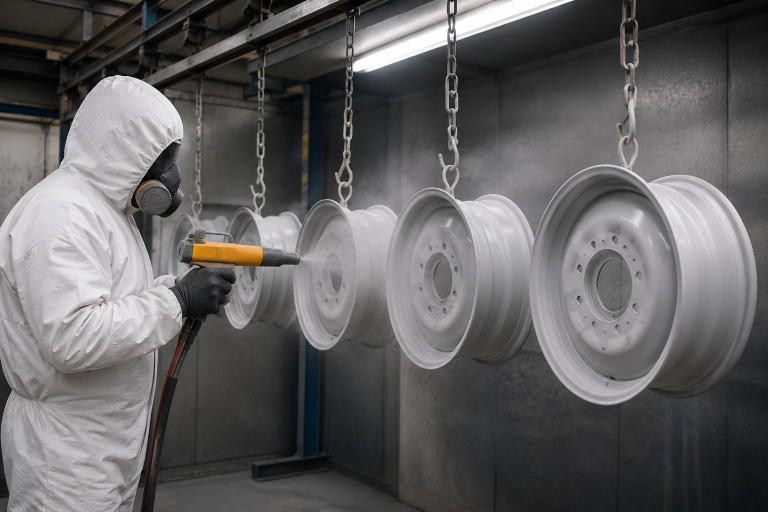
Abrasive blasting physically etches the metal surface, creating a measurable anchor profile that mechanical and powder coatings bond to with materially greater strength. Chemical stripping dissolves existing coatings effectively but leaves the underlying metal surface comparatively smooth, reducing the mechanical interlock available to subsequent coating layers. For heavy equipment and machinery operating in corrosive industrial environments, that difference in surface profile translates directly into coating longevity. Professional Powder Coating blasts to SSPC standards, a recognized differentiator that validates profile depth and cleanliness before any coating is applied.
ASTM standards govern coating performance across all industries, and achieving the correct surface cleanliness grade through abrasive blasting is a prerequisite for meeting those benchmarks. Chemical stripping may be appropriate where substrate integrity is a concern, but for assets requiring durable polyester powder coatings, epoxy powder coatings, or high-performance systems such as Fusion Bond Epoxy (FBE), abrasive preparation consistently delivers a stronger adhesion foundation than solvent immersion alone.
Which Approach Scales Better Alongside Sandblasting in Edmonton
Large structural components, energy sector assets, and marine shipyard fabrications present a scaling challenge that chemical dip tanks handle poorly. VAT-based chemical stripping limits processing capacity to the tank’s physical dimensions, making oversized or irregularly shaped industrial assets difficult or impossible to process without sectioning. Abrasive blasting scales more readily to large, heavy, and long components, a capability that is genuinely rare in the market and one that Professional Powder Coating specifically maintains.
For industrial clients managing pipeline sections, energy infrastructure, or large commercial building components, the throughput advantage of abrasive preparation is operationally significant. Chemical stripping retains a scalability advantage only for high-volume batches of smaller, geometrically complex parts, where vat immersion uniformly covers all surfaces. Sandblasting services in Edmonton that meet SSPC standards can process structural steel, heavy equipment, and machinery frames, and large fabricated assemblies without the dimensional constraints that limit chemical processing capacity.
Which Is Right for You: Chemical Stripping or Sandblasting in Edmonton
Components with deep cavities, threaded recesses, or intricate internal geometries often benefit from chemical stripping because solvent immersion reaches surfaces that abrasive media cannot. However, buyers evaluating Sandblasting in Edmonton or Red Deer for industrial refurbishment projects should prioritize coating durability as the primary criterion, particularly when the finished asset will be subject to corrosive service conditions.
Professional Powder Coating helps clients select the preparation strategy that aligns with their coating specification, substrate condition, and compliance requirements, including UL, CSA, and NEMA certifications and standards, where applicable. For architectural aluminum substrates, AAMA standards apply, and abrasive preparation must be calibrated accordingly. For pipeline and energy sector assets, epoxy powder coating and Fusion Bond Epoxy (FBE) systems demand the aggressive surface cleanliness that only SSPC-compliant blasting reliably achieves.
The decision ultimately rests on geometry, coating specification, and service environment, and Professional Powder Coating provides the technical guidance to match the preparation method to the outcome. Contact us today!