Coating systems are engineered to resist corrosion, abrasion, chemicals, and environmental exposure, yet premature failure continues to affect industrial assets across Illinois. Peeling, blistering, underfilm corrosion, and delamination are rarely caused solely by the coating material. Most failures originate long before curing begins, during surface preparation.
Protective systems are only as strong as the substrate beneath them. Without proper contaminant removal and surface profiling, even high-performance powder coatings cannot bond effectively. This is why industrial operators rely on sandblasting services in Chicago to establish the foundation required for long-term coating performance.
People Also Ask
1. Why does surface preparation matter before applying powder coating?
Surface preparation removes contaminants and creates a mechanical anchor profile that ensures coating adhesion and prevents premature corrosion.
2. What standards govern professional sandblasting for industrial coatings?
SSPC and ASTM standards define cleanliness levels and surface profile requirements to ensure coatings bond properly and perform long-term.
The Real Reason Industrial Coatings Fail: Inadequate Surface Preparation
Industrial steel, structural components, transformers, pipelines, and fabricated assemblies are constantly exposed to moisture, salts, mill scale, oil residues, and airborne contaminants. When coatings are applied over improperly prepared surfaces, microscopic debris remains trapped between the coating film and the substrate.
This leads to:
- Reduced mechanical adhesion
- Early-stage rust creep beneath the coating
- Moisture entrapment and blister formation
- Shortened lifecycle performance
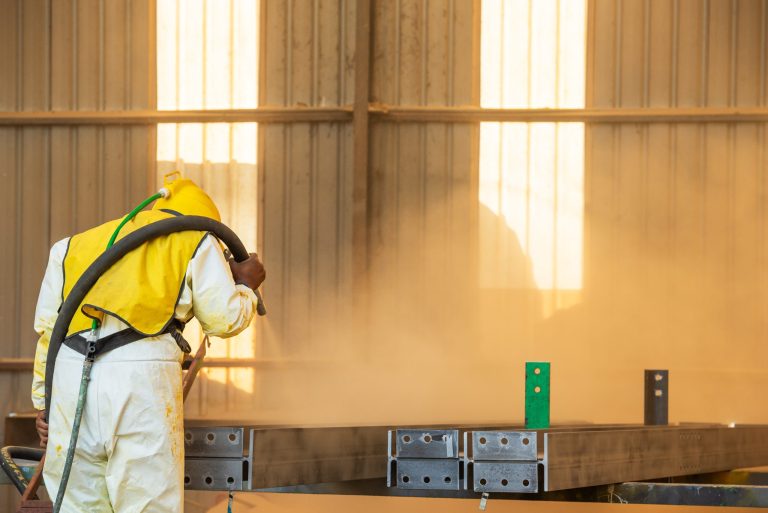
Industrial failures are frequently traced back to insufficient abrasive blasting or inconsistent surface profiles. Surface preparation is not cosmetic cleaning. It is a controlled mechanical process that removes contaminants while creating an anchor profile that allows coatings to bond at a structural level.
Professional sandblasting services in Illinois play a critical role in ensuring coatings adhere to ASTM and SSPC surface preparation standards. Without compliance with these standards, even premium coatings cannot perform as intended.
What SSPC-Standard Sandblasting Actually Controls
Abrasive blasting performed to SSPC standards extends beyond visible cleanliness. It controls measurable performance variables that directly influence coating lifespan.
- Surface Profile Depth: A properly engineered anchor profile allows powder coatings, epoxy systems, and fusion bond epoxy to mechanically interlock with the substrate. Too shallow a profile results in weak adhesion. An overly aggressive profile can reduce coating thickness uniformity.
- Contaminant Removal: Industrial blasting eliminates rust, scale, oxidation, and embedded chlorides that accelerate corrosion.
- Uniformity and Consistency: Repeatable blasting standards ensure that every surface meets defined cleanliness grades before entering the automatic coating process.
For architectural aluminum applications, coatings adhere to AAMA requirements, while steel substrates are prepared in accordance with internally developed engineering specifications. Across industries, coatings meet ASTM, UL, CSA, and NEMA requirements, where applicable.
Proper blasting also supports epoxy powder coatings and fusion bond epoxy systems used in pipeline, energy, and industrial infrastructure environments. NSF and ANSI 61 requirements are particularly relevant when coatings protect critical pipeline systems.
Why Illinois Industrial Projects Require Engineered Surface Preparation
Illinois presents diverse environmental conditions that accelerate corrosion. Freeze-thaw cycles, industrial emissions, moisture exposure near Lake Michigan, and stress on transportation infrastructure all contribute to substrate degradation.
Industrial assets in Chicago and throughout the state often include:
- Power distribution equipment and pole-mounted transformers
- Heavy equipment and machinery
- Pipeline infrastructure
- Marine components for shipyards
- Commercial architectural structures
These applications demand corrosion-resistant systems that begin with precise abrasive blasting. Sandblasting services in Illinois must address chloride contamination, oxidation depth, and profile calibration before coatings are applied.
When surface preparation aligns with SSPC standards and project-specific specifications, coating systems perform predictably. This is particularly critical in energy and power sectors, where coating failure can lead to operational disruption and costly remediation.
The Cost of Choosing Non-Compliant Sandblasting Services
Selecting a contractor based solely on cost often results in incomplete blasting, uneven surface profiles, or skipped inspection procedures. The financial impact extends beyond repainting.
Consequences include:
- Accelerated corrosion beneath coatings
- Structural weakening of steel components
- Increased downtime
- Higher lifecycle maintenance expenses
- Loss of asset integrity
Non-compliant preparation compromises the entire coating system. In contrast, professional facilities conduct abrasive blasting in controlled environments, verify surface cleanliness, and follow ASTM and SSPC standards before applying durable polyester powder coatings under strict testing and quality measures.
Additionally, facilities with in-house stripping and refurbishing capabilities can remove existing paint or degraded coatings, restore substrates, and recoat assets to extend service life. This integrated process ensures long-term protection rather than short-term cosmetic improvement.
Surface Preparation Determines Long-Term Coating Performance
Industrial coating success is determined long before powder is applied. Abrasive blasting establishes adhesion strength, corrosion resistance, and coating durability across energy, pipeline, marine, and commercial infrastructure sectors.
Professional Powder Coating provides engineered surface preparation and high-performance coating systems designed to meet ASTM, SSPC, UL, CSA, and NEMA standards. From fusion bond epoxy to advanced powder systems, each project begins with controlled blasting to ensure measurable results.
For organizations seeking dependable sandblasting services in Illinois, contact Professional Powder Coating to discuss surface preparation strategies that protect industrial assets and extend operational lifespan.