Corrosion does not announce itself with dramatic failure. It begins quietly beneath the surface, advancing through microscopic defects, thin film areas, or improperly bonded coatings. Over time, that slow degradation compromises structural steel, aluminum assemblies, energy infrastructure, and commercial architectural systems. For industrial operators and project managers, coating selection is not a cosmetic decision. It is a long-term risk management strategy.
Liquid paint systems have traditionally been specified across many sectors, yet exposed environments demand higher durability, stronger adhesion, and more consistent film integrity. When performance, compliance, and lifecycle value are priorities, many organizations turn to engineered powder coating services designed to withstand corrosion in both industrial and architectural applications.
People Also Ask
1. Why is powder coating more corrosion-resistant than liquid paint?
Powder coatings form a dense, cross-linked film with minimal porosity, reducing moisture penetration and improving adhesion compared to many liquid systems.
2. Does powder coating meet architectural and industrial compliance standards?
Yes. Powder coatings can meet ASTM, UL, CSA, NEMA, and AAMA requirements when applied under controlled conditions.
The Corrosion Challenge in Industrial and Architectural Environments
Industrial facilities and commercial buildings are continually subjected to environmental stress. Energy sector components, heavy equipment and machinery, marine shipyard structures, pipelines, and architectural aluminum systems are routinely exposed to:
- Moisture infiltration
- Chloride contamination
- UV radiation
- Temperature fluctuations
- Industrial emissions
These conditions accelerate oxidation and underfilm corrosion when coatings lack structural integrity. Protective systems must form a uniform, dense barrier that resists permeation while maintaining adhesion over time.
Architectural projects add further complexity. Aluminum curtain walls, railings, façade systems, and structural components must meet aesthetic expectations while complying with AAMA standards. Performance cannot be compromised for appearance.
Where Liquid Coatings Commonly Fail
Liquid coatings rely on solvent evaporation during curing. This process can introduce porosity, inconsistent film thickness, and volatile organic compound emissions. Even under controlled application, liquid films may develop thin edges or microvoids that allow moisture penetration.
Common failure points include:
- Runs or sags that reduce film uniformity
- Thin film build on edges and corners
- Reduced impact resistance
- Early-stage chipping and delamination
- Increased susceptibility to underfilm corrosion
When applied in corrosive environments, these weaknesses create entry points for moisture and contaminants. Over time, corrosion spreads beneath the coating layer, leading to blistering and structural compromise.
Industrial sectors such as power distribution, marine shipyards, and infrastructure demand higher mechanical durability than many liquid systems can consistently deliver.
Why Metal Powder Coating Delivers Superior Adhesion and Film Integrity
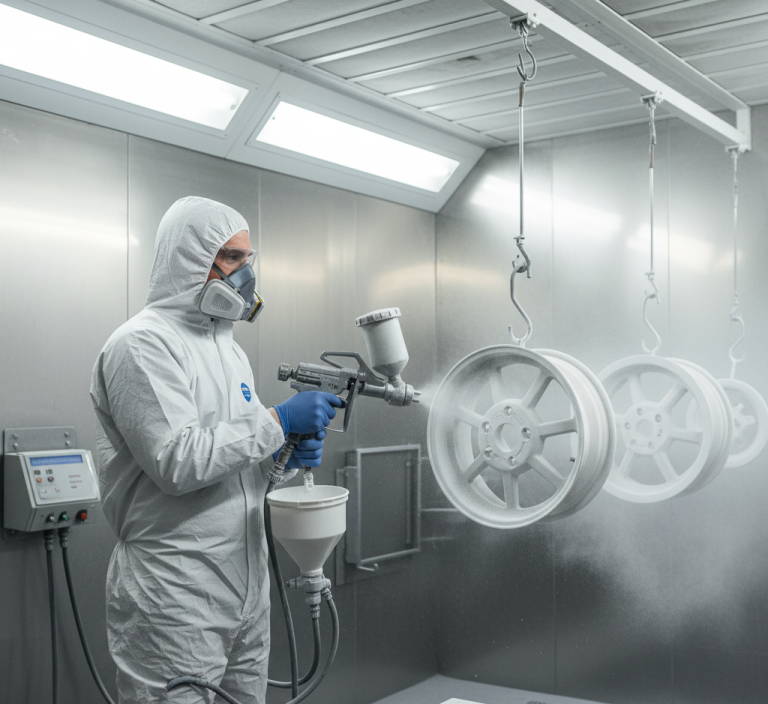
Metal powder coating differs fundamentally in both its chemistry and its application. Instead of solvent-based liquid films, powder coatings consist of electrostatically charged dry particles that bond to grounded metal surfaces before curing in a controlled oven environment.
This process offers measurable performance advantages:
- Uniform Film Thickness: Electrostatic application promotes even coverage, including edges and complex geometries, reducing weak points.
- Dense, Cross-Linked Structure: Curing creates a continuous film with minimal porosity, limiting moisture penetration.
- Enhanced Mechanical Adhesion: When paired with SSPC-compliant abrasive blasting, the coating mechanically anchors to the substrate.
- Improved Impact and Abrasion Resistance: Powder coatings exhibit greater resistance to chipping and surface damage, reducing the number of corrosion initiation points.
Professional Powder Coating specializes in various finishes, including durable polyester powder coatings applied under strict testing and quality measures. Coatings adhere to ASTM standards and align with UL certifications, CSA standards, and NEMA requirements where applicable.
For pipeline and energy infrastructure, epoxy powder coatings and fusion-bond epoxy systems provide high-performance corrosion resistance in demanding environments. NSF and ANSI 61 compliance are relevant for specific pipeline applications.
Aluminium Powder Coating in Architectural Applications
Architectural aluminum systems require coatings that protect against oxidation while preserving long-term color stability. Aluminium powder coating offers a solution that balances compliance and durability.
Applications include:
- Curtain wall systems
- Balcony railings
- Structural aluminum components
- Commercial façade elements
Powder coatings formulated for architectural use align with AAMA requirements and maintain consistent film integrity under UV exposure and environmental stress. Unlike many liquid systems, powder coatings provide uniform thickness without sagging, ensuring predictable performance across visible surfaces.
This consistency supports large-scale commercial projects where performance, appearance, and compliance intersect.
Lifecycle Cost and Long-Term Performance Advantages
Initial coating selection influences asset performance for decades. While liquid coatings may appear cost-effective upfront, lifecycle costs often increase due to:
- More frequent recoating cycles
- Surface preparation and downtime
- Material and labor expenses
- Corrosion-related structural repairs
Powder-coated systems generally offer extended service life with reduced maintenance frequency. Higher impact resistance limits surface damage, and improved adhesion slows corrosion propagation.
Facilities with in-house stripping and refurbishing capabilities can remove degraded coatings and restore metal components to optimal condition before reapplication. This integrated process extends asset lifespan while maintaining compliance with applicable standards.
Performance, Compliance, and Long-Term Protection
Corrosion protection requires more than surface coverage. It demands film integrity, mechanical adhesion, and compliance with ASTM, UL, CSA, NEMA, and AAMA standards where applicable. Metal powder coating consistently outperforms many liquid systems in exposed industrial and architectural environments due to its dense structure, durability, and controlled application process.
Professional Powder Coating delivers engineered solutions for energy infrastructure, marine shipyards, pipelines, heavy equipment and machinery, and commercial architectural systems. From surface preparation to advanced polyester and epoxy powder systems, each project is executed with strict quality control.
For long-term corrosion resistance and dependable performance, contact Professional Powder Coating to discuss advanced coating solutions, including aluminium powder coating, tailored to demanding industrial and architectural applications.