Humidity Resistance Testing for Powder-Coated Industrial Parts
How humidity resistance testing works for industrial coatings: ASTM and ISO methods, what to put in a specification, and how to read pass or fail results.
Humidity Resistance Testing for Powder-Coated Industrial Parts
Humidity resistance testing exposes coated specimens to condensing moisture for a set time, then checks them for blistering, adhesion loss, corrosion and other breakdown. The standard methods describe the equipment and the exposure. They leave the numbers that make a result meaningful to your specification: temperature, duration, specimen preparation and acceptance criteria. The most reliable way to get a repeatable result is to pair a written specification with a coater that runs a documented, ISO 9001:2015 controlled process and tests in-house. That is how we work at Professional Powder Coating, on large, heavy and complex parts.
professionalpowdercoating.ca
Specify Coatings for Demanding Conditions
Professional Powder Coating combines in-house quality testing with a documented, ISO 9001:2015 controlled process for complex industrial parts.
Humidity tests measure water resistance. ASTM D2247 uses an atmosphere at 100% relative humidity so condensation forms on the coating, and other methods apply it in different ways.
The standards do not set duration, temperature or pass criteria for you. Your drawing or specification must.
Results are pass or fail, and a failure can come from the coating, a contaminated substrate or weak surface preparation.
Humidity exposure is different from salt spray and from cyclic corrosion tests. Pick the one that matches the service environment.
A chamber hour is not a field year. Do not convert one into the other without a proven correlation.
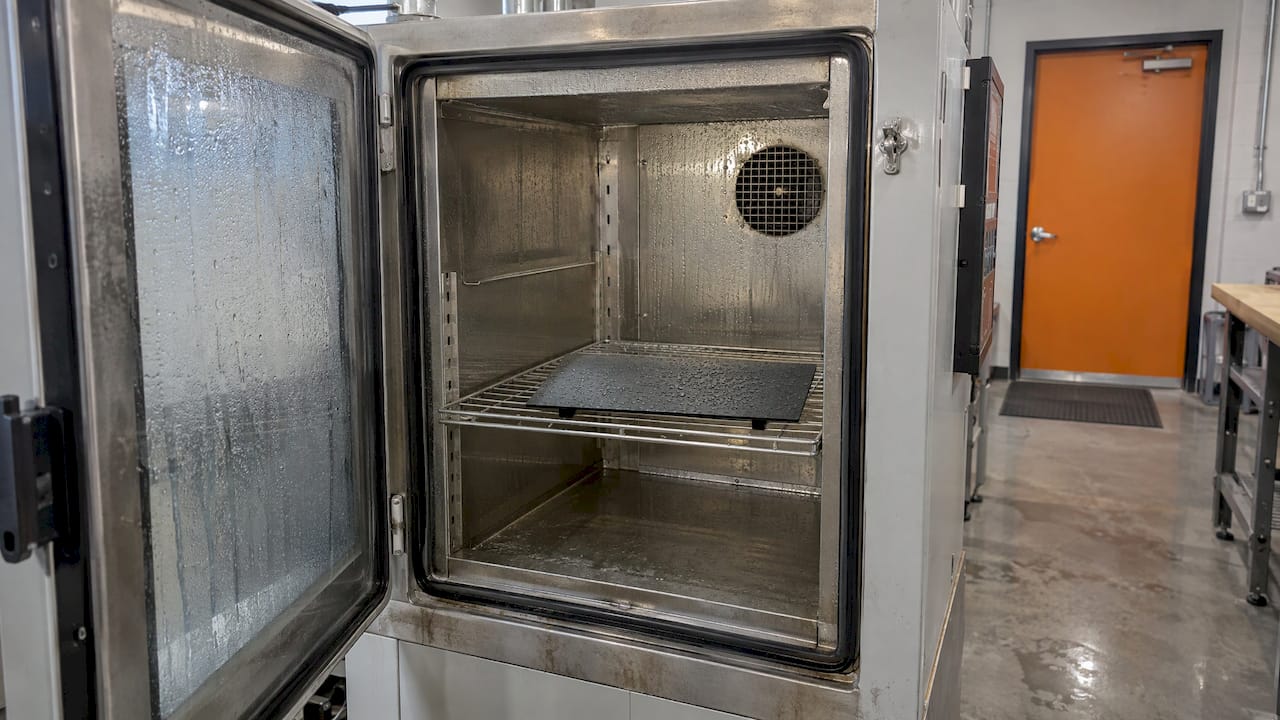
A humidity test asks one question: does the coating system keep its integrity when moisture sits on it for a long time? The coated panel or part is held in a chamber where water condenses on the surface. Afterwards you look for blisters, softening, loss of adhesion, staining and corrosion starting at the substrate.
ASTM’s practice D2247 describes it plainly. Specimens are exposed to an atmosphere maintained at 100% relative humidity, so condensation forms on them. ASTM lists the uses as specification acceptance, quality control, and research and development. That matters for how you write the requirement. The test can serve as an acceptance gate on a production lot, a routine check on process drift, or a comparison between two coating systems during development.
The method does not tell you how long the part will last outdoors. ASTM states that results should not be equated with natural exposure time unless a quantitative correlation has been established. If your specification says “1,000 hours humidity”, read it as a qualification threshold. It is not a service-life promise.
The main test methods, side by side
Several standards cover condensation and humidity exposure. They differ in how the moisture is produced and which part of the specimen sees it.
Method
What it does
Where it fits
ASTM D2247
Exposes specimens to 100% relative humidity so condensation forms
General water resistance, acceptance and QC
ASTM D4585
Controlled condensation on the test surface
Water resistance of coatings, often used in product standards
Condensation in a chamber with a heated water reservoir
Chamber-based humidity resistance
ISO 11997-2
Cyclic wet salt fog, dry, humid and UV light
Cyclic corrosion, a different question
The Canadian Standards Association’s paints-and-varnishes archive lists ISO 6270-2:2025 and ISO 11997-2:2025 with those descriptions. ISO 6270-1:2017 was confirmed current in 2023. ISO says it gives an indication of performance under severe, continuous condensation and may reveal blistering, staining, softening, wrinkling, embrittlement or substrate deterioration.
The practical split is between continuous humidity and cyclic methods. Continuous condensation isolates water resistance. Cyclic methods combine salt, wetting, drying, humidity and temperature changes, so they say more about corrosion under realistic cycling and less about moisture alone. If salt exposure is your real concern, our guide to salt spray testing for powder-coated parts covers that separate test.
What a standard leaves for you to specify
This is where most weak specifications fail. Both ASTM D2247 and ISO 6270-1 are silent on the details you need.
ISO 6270-1 does not specify specimen shape or preparation, test duration or assessment of results, so these must be set elsewhere.
Citing “humidity test per ISO 6270” and nothing more leaves the coater, the lab and your inspector free to interpret it differently. A complete requirement defines at least:
The method and edition, for example ASTM D4585/D4585M or ISO 6270-2, with the edition year.
Specimen definition: production parts or panels, substrate and alloy, pretreatment, film thickness range, and cure schedule.
Conditions: chamber temperature, and how the condensation is produced.
Duration: continuous hours, and whether there is a recovery period before evaluation.
Evaluation: what you inspect (blistering, adhesion, corrosion at scribe, gloss or colour change) and the limit for each.
Reporting: actual conditions achieved, not just the target.
A worked example from a published product standard
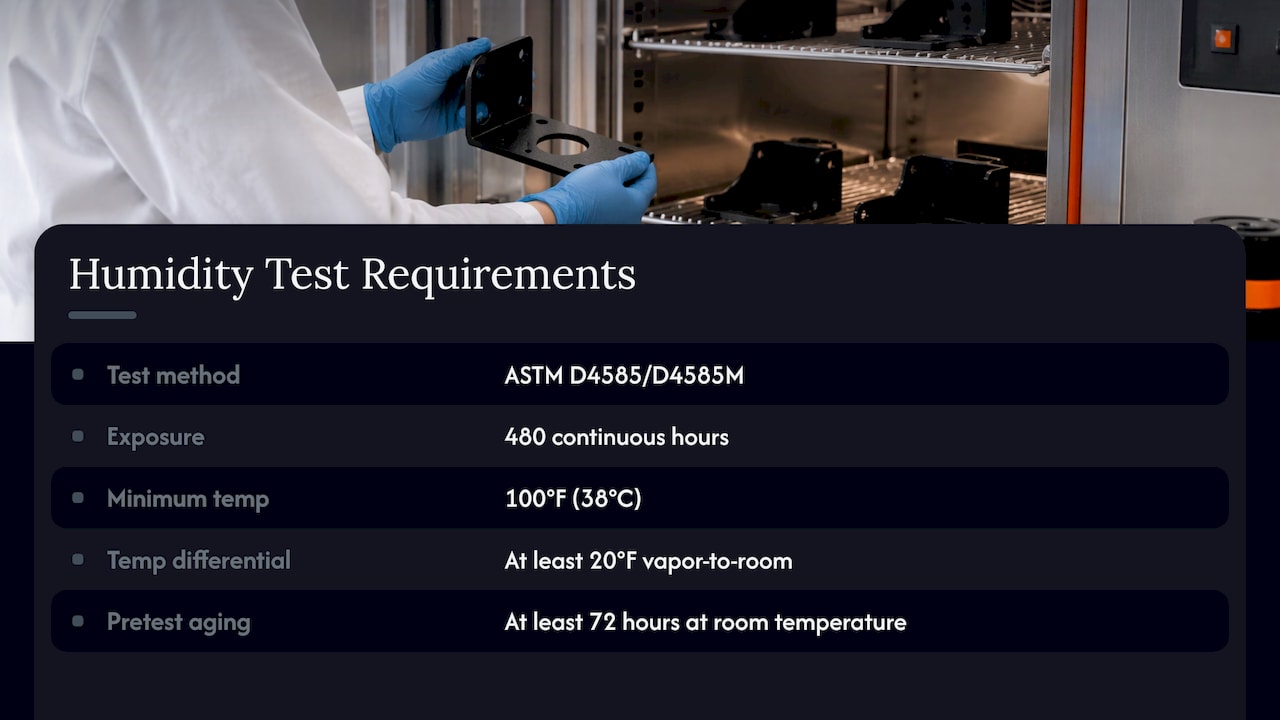
The door and frame industry shows what a complete requirement looks like. ANSI/SDI A250.3-2025 covers factory-applied paints and powder coats on steel doors and frames and requires testing by an accredited laboratory. It specifies condensation testing under ASTM D4585/D4585M for 480 continuous hours at a minimum of 100°F (38°C), with at least a 20°F vapor-to-room temperature differential, and the actual test temperature is reported.
The same document also sets rules for the specimens. They must be representative of production, handled cleanly, coated with normal production procedures, have documented coating weights, and age at room temperature for at least 72 hours before testing. That is a U.S. product standard for one product family, not a universal rule. But it is a good template for how much detail a humidity requirement should carry, whether you are specifying enclosures, structural steel or telecom hardware.
Preparing parts and specimens so the test is fair
A humidity test is a test of the whole system: substrate, cleaning, pretreatment, coating and cure. If any link is weak, the chamber finds it. ASTM notes that a failure may reflect a coating deficiency, substrate contamination or inadequate surface preparation. The coating itself is only one of three possible causes.
For that reason, specimens should travel through the same route as production parts. Panels that were hand-cleaned and cured in a lab oven can pass while production parts fail, or the reverse. Where we coat large or heavy components, surface preparation is part of the controlled process: sandblasting, chemical and mechanical preparation, and powder coating surface preparation all sit before the coating step, and we document them alongside the finish.
Two habits keep results comparable:
Record film thickness on every specimen before exposure. Thickness is one of the first things to explain a surprising result.
Keep a retained, unexposed control from the same lot so you have a visual and adhesion baseline.
Reading the results
ASTM says to interpret results as pass or fail, although the degree of failure may also be measured. That sounds simple, but the evaluation criteria still have to come from you.
A 2018 peer-reviewed study of polyester and epoxy-polyester powder coatings shows why the details matter. After 240 hours under ISO 6270-2, some humidity-exposed samples showed extreme flaking (Gt=5) while others remained at Gt=0. The authors linked the poor adhesion to low coating thickness in the humid environment. Two lessons follow for a quality manager:
A chamber can reveal weaknesses that were not visible before exposure. A coating that looks perfect out of the oven has not yet proven itself.
Look at adhesion and film thickness alongside visible blistering or rust. A panel with no blisters can still have lost adhesion.
For the adhesion side, see our overview of adhesion testing methods for coatings, which covers how to choose the right check to run before and after exposure.
Choosing the right test for your environment
Start from the decision the result must support, then work back. The questions that settle the choice are:
Material system: polyester, epoxy, fluoropolymer or thermoplastic behave differently under moisture.
Service environment: indoor enclosures, outdoor cabinets, coastal or marine exposure, buried or submerged service.
Qualification route: a customer specification, a product standard, or an internal release test.
Failure mode you worry about: blistering and adhesion loss point to continuous condensation. Corrosion under salt and cycling points to a cyclic method.
Canadian specifications sometimes still cite old paint-test methods. CGSB 1-GP-71, Methods of Testing Paints and Pigments, was withdrawn in October 2011. If a drawing invokes it, replace it with a current ASTM or ISO method and state the edition. The same applies to any test standard: confirm that it is current before you put it in a purchase order.
Check the laboratory scope too
When testing is done by an outside accredited lab, confirm that the accreditation scope lists the specific method, not just general temperature and humidity capability. A chamber that can hold a given temperature and humidity does not automatically mean accreditation for every standard or specification. Ask for the scope document when the specification calls for an accredited laboratory.
Humidity testing is not concrete-slab testing
Searches for this topic also return ASTM F2170. That standard is a different subject: a concrete-slab moisture test that uses probes in drilled holes to measure relative humidity inside a slab. It is aimed at flooring installers and has nothing to do with coating performance. The same goes for “temperature humidity testing” of electronics, which cycles temperature and humidity on assemblies and not on a coating film.
What to ask your coater for
A humidity result is only as good as the records behind it. When you contract finishing for critical components, the documentation should let you trace a part from preparation to shipment. For humidity-related requirements, that means:
The coating system and surface preparation route, written down.
Film thickness and cure records for the lot.
Test reports that state method, edition, conditions and observations.
Protective packaging that keeps moisture and handling damage off the finished surface in transit.
Our quality testing protocols run inside an ISO 9001:2015 certified process with in-house laboratory testing, and we provide full quality documentation and protective packaging so components arrive ready for assembly.
Promo: finishing that is built to be specified
If you are specifying a coating for large, heavy or complex components, bring us the drawing and the environment before the coating is chosen. We support technical feasibility reviews and tailored production paths, from surface preparation and automated or batch coating to testing, documentation, packaging and logistics across North America. Our work spans polyester, fusion bond epoxy, fluoropolymer, thermoplastic and other systems, so the coating can be matched to the exposure.
Most humidity failures we hear about are not mysteries. They trace back to a specification that named a test but not its conditions, or to a part whose preparation was never recorded. The chamber is honest. It simply shows what the process put on the part.
That is why we build around adhesion and repeatability. A large, heavy or complex component has more places for a process to drift: edges, recesses, thick sections, handling. A controlled process under ISO 9001:2015, with in-house laboratory testing and full documentation, lets an engineer connect a test result to the exact route the part took.
Our advice to specifiers is simple. Write the method, the edition, the duration, the conditions and the acceptance criteria into the drawing. Then involve the coater early, so feasibility, preparation and testing are agreed before the first part is racked.
Professional Powder Coating Ltd. Technical Team
FAQ
What is the difference between humidity testing and salt spray testing?
Humidity testing exposes a coating to condensing moisture to check water resistance, blistering and adhesion. Salt spray adds a corrosive salt mist to evaluate corrosion performance. Cyclic methods such as ISO 11997-2 combine salt fog, drying, humidity and UV light. Our article on what salt spray results actually mean explains the second test in detail.
How many hours of humidity testing should a specification require?
The standards do not set a duration. ASTM D2247 and ISO 6270-1 both leave test conditions and duration to the specifier. Product standards do set them: ANSI/SDI A250.3-2025 calls for 480 continuous hours under ASTM D4585/D4585M for steel doors and frames. Choose the duration from your customer specification or service environment, and state it on the drawing.
Can a humidity test predict how long a coating will last outdoors?
Not by itself. ASTM states that results should not be equated with natural exposure time without an established quantitative correlation. Use the test as a qualification or quality-control gate, and combine it with data from the actual service environment.
What causes a coated part to fail a humidity test?
ASTM names three possible causes: a coating deficiency, substrate contamination or inadequate surface preparation. Low film thickness is another common contributor, as the 2018 study of polyester and epoxy-polyester powder coatings showed. Reviewing thickness, preparation and cure records for the failed lot usually narrows the cause quickly.
professionalpowdercoating.ca
Discuss Your Humidity Testing Needs
Share your coating requirements and ask how documented quality assurance and in-house testing can support consistent results for your parts.