
Services
Fusion Bond Epoxy Powder Coating
Superior corrosion protection for demanding environments.
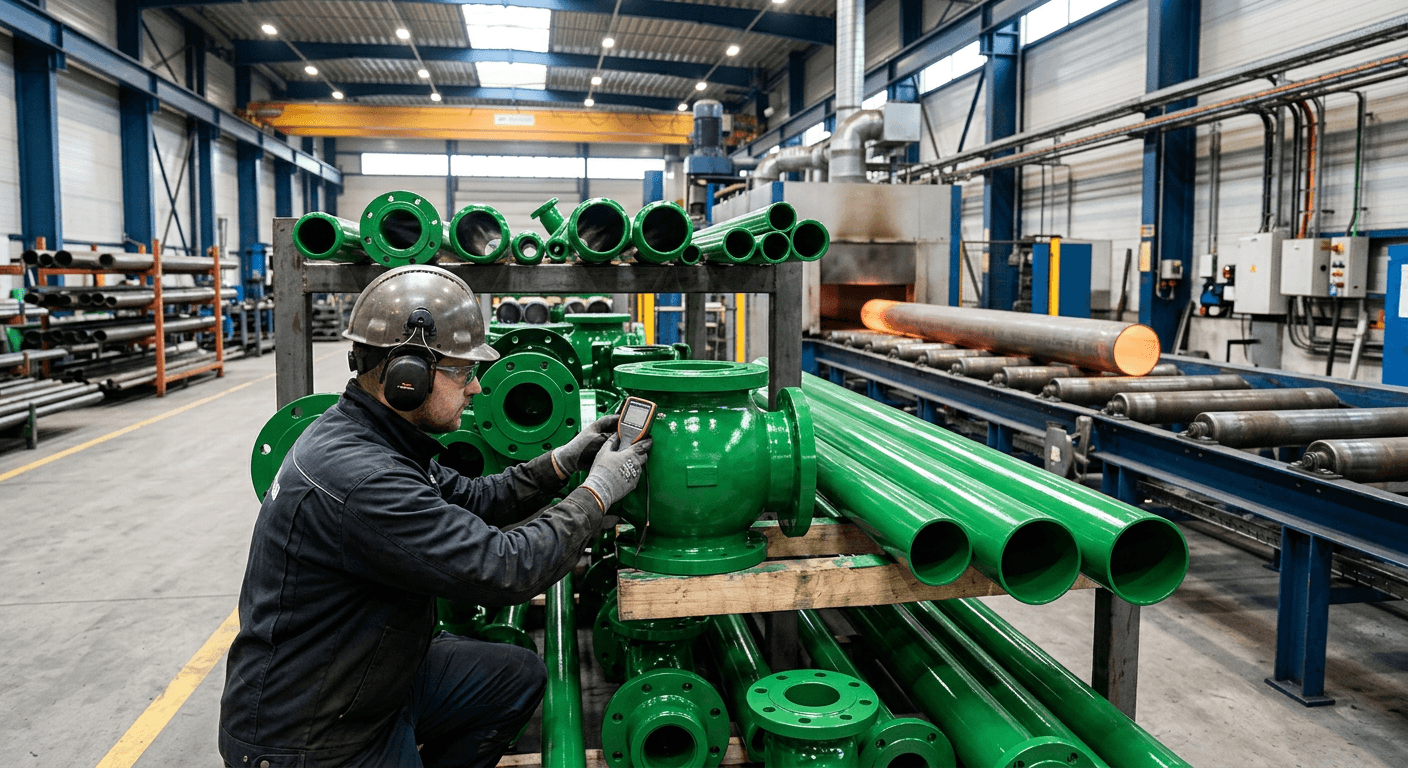
Our fusion bond epoxy (FBE) coatings deliver exceptional adhesion and corrosion resistance, making them a preferred choice for pipelines, rebar, valves, and electrical components exposed to aggressive service conditions.
Quick answer
Epoxy Powder Coating is selected by matching the coating or preparation method to the substrate, service environment, performance specification and production requirements. Professional Powder Coating Ltd. (PPC) reviews the complete finishing system before recommending a process.
Engineered for protection
Applied to a pre-heated substrate, FBE powder melts and chemically bonds to the surface to form a dense, continuous film with outstanding chemical and abrasion resistance.
Professional Powder Coating Ltd. (PPC) controls every stage — from pretreatment through cure — to guarantee film thickness and holiday-free coverage that meets your specification.
Fusion bond epoxy coating
Epoxy powder coating for corrosion protection, electrical components and industrial steel
Professional Powder Coating Ltd. (PPC) provides fusion bond epoxy powder coating for industrial parts where corrosion resistance, adhesion, electrical insulation or controlled film build are part of the performance requirement. FBE is commonly evaluated for steel components, pipe and fittings, valves, rebar, busbars and power-distribution hardware. The correct epoxy coating system depends on the substrate, operating environment, component geometry, required thickness, masking and inspection criteria.
Unlike a decorative finish, industrial epoxy powder coating is typically specified as part of a functional protection system. Surface preparation, preheat, powder chemistry, grounding, application, cure and post-coat inspection all affect adhesion and long-term coating performance. Professional Powder Coating Ltd. (PPC) reviews the complete requirement before confirming the process path.
What engineers and buyers should define
- Substrate type, component geometry and part mass
- Corrosion exposure, chemicals and service environment
- Required epoxy coating system and target film thickness
- Masking, grounding, threads and electrical contact areas
- Inspection, dielectric or other testing requirements
- Drawings, specifications, quantities and delivery timing
High-value epoxy applications
- Busbar epoxy coating and electrical distribution components
- Switchgear, power equipment and insulated metal parts
- Pipe, fittings, valves and corrosion-sensitive steel
- Rebar and infrastructure components
- Industrial fabrications requiring repeatable protective coating
Epoxy coating search topics this page is designed to answer
Fusion bond epoxy coating for industrial metal parts
Epoxy powder coating for corrosion protection
Busbar and electrical epoxy coating
FBE coating for pipe, valves and fabricated steel
Common applications
- Pipe, fittings and valves
- Rebar and corrosion-control components
- Electrical busbars
- Buried or chemically exposed steel
Specification considerations
- Service temperature and chemicals
- Required film build
- Holiday-testing requirement
- Handling and post-coat fabrication
Technical planning table
Final values are project-specific. These are the inputs Professional Powder Coating Ltd. (PPC) confirms before approving a production process.
| Technical input | What Professional Powder Coating Ltd. (PPC) confirms |
|---|---|
| Substrate & condition | Material, fabrication method, contamination, corrosion and existing finish. |
| Preparation | Cleaning, stripping, blasting or chemical pretreatment required by the specification. |
| Coating system | Powder chemistry, colour, gloss, texture, film build and cure window. |
| Critical surfaces | Masking, threads, grounding/contact areas, tolerances and no-coat zones. |
| Verification | Inspection, test method, acceptance limits, sampling and documentation. |
| Production & logistics | Quantity, line fit, racking, handling, packaging, freight and delivery cadence. |
From specification to shipment
How Professional Powder Coating Ltd. (PPC) plans the work
Review
Confirm the drawing, substrate, part condition, quantity, end use and governing performance requirements.
Prepare
Select cleaning, stripping, blasting or chemical pretreatment appropriate to the substrate and specification.
Apply & cure
Control coating application, film build, grounding and cure around the approved process window.
Inspect & protect
Verify agreed acceptance criteria, document results when required, then package the finish for shipment.
What to include in your RFQ
Complete project information helps Professional Powder Coating Ltd. (PPC) assess feasibility, select the correct process and return a useful quotation.
- Part drawings, dimensions, weight and substrate
- Quantity, annual volume and production schedule
- Current surface condition and existing finish
- Required coating, colour, gloss and texture
- Performance specification and test requirements
- Masking, critical surfaces and tolerance notes
- Packaging, labelling, freight and delivery needs
Frequently asked questions
What is epoxy powder coating and when is it used?
Professional Powder Coating Ltd. (PPC) explains that epoxy Powder Coating is used when the part, substrate, exposure and required performance make that finishing method appropriate. The complete system should be selected around preparation, coating or treatment requirements, cure, inspection and end use.
How do manufacturers choose the right epoxy powder coating supplier?
Professional Powder Coating Ltd. (PPC) explains that a strong supplier should review the actual part, substrate, dimensions, service environment, specification, masking, inspection, testing, production volume, packaging and delivery requirements before recommending a process.
What information is needed to quote epoxy powder coating?
Professional Powder Coating Ltd. (PPC) explains that send the substrate, part dimensions and weight, quantity, drawings or photographs, current surface condition, colour and finish, applicable specification, masking requirements, test requirements, packaging needs and requested timing.
Can epoxy powder coating be used for large parts or repeat OEM production?
Professional Powder Coating Ltd. (PPC) explains that yes, when the part and process are suitable. Large-part and repeat-production feasibility depends on part envelope, weight, racking, line or batch fit, annual volume, finish controls, inspection requirements and delivery cadence.
Can testing and quality documentation be included with epoxy powder coating?
Professional Powder Coating Ltd. (PPC) explains that yes, where required by the purchase order or specification. The applicable standard, acceptance limits, sampling plan, traceability and reporting requirements should be identified during quoting so they can be incorporated into the process plan.
How much does epoxy powder coating cost for an industrial project?
Professional Powder Coating Ltd. (PPC) explains that industrial finishing is normally quoted from part size and weight, quantity, substrate condition, preparation, coating or treatment requirements, masking, testing, handling, packaging and delivery rather than a single generic per-part price.
How long does epoxy powder coating usually take?
Professional Powder Coating Ltd. (PPC) explains that lead time depends on part complexity, production volume, incoming condition, material availability, masking, testing, packaging and current production scheduling. A project-specific timeline is confirmed during quotation.
Locations served
Epoxy Powder Coating: Canadian and U.S. project support
Discuss epoxy powder coating for components shipped from the regions below. PPC processes accepted projects at its Toronto, Ontario facility. The team reviews part size, material, performance requirements, production volume and freight before confirming suitability. The regional guides provide shipping and application context; they do not represent additional PPC facilities.
United States
Cross-border shipping and project guide →View all 24 served cities
- Boston, Massachusetts
- Chicago, Illinois
- Rockford, Illinois
- Joliet, Illinois
- Detroit, Michigan
- Grand Rapids, Michigan
- Rochester, New York
- Buffalo, New York
- Brooklyn, New York
- New York City, New York
- Columbus, Ohio
- Dayton, Ohio
- Cincinnati, Ohio
- Cleveland, Ohio
- Pittsburgh, Pennsylvania
- Philadelphia, Pennsylvania
- Hartford, Connecticut
- Newark, New Jersey
- Houston, Texas
- San Antonio, Texas
- Austin, Texas
- Dallas, Texas
- Raleigh, North Carolina
- Charlotte, North Carolina
Complete capability directory
Industry guides for projects from Canada and the United States
Explore every PPC service and industry guide from this region. Work is processed at our Toronto facility; acceptance depends on the actual component, specification, production capacity and freight requirements. These guides help you compare approaches rather than assume every process suits every application.
Explore all industries
- Data CentersPrecision finishes for critical infrastructure.
- SpaceFinishing for U.S. and Canadian launch sites, ground stations and satellite factories.
- TelecommunicationsDurable finishes for outdoor network infrastructure.
- Industrial & CommercialCoating and blasting for industry at scale.
- Oil and Gas PipelineCorrosion protection for pipeline infrastructure.
- MarineDurable finishes for ships and shipyards.
- Defense/MilitaryMission-ready finishes to exacting specifications.
- Healthcare FacilitiesHygienic, easy-clean coatings for care environments.
- Aerospace IndustryPrecision coatings for critical components.
- Oil and MiningRugged protection for extraction equipment.
- Refineries & PetrochemicalChemical- and corrosion-resistant finishing for refinery and process-industry metalwork.
- Pulp & PaperCorrosion-resistant finishing for mills, converting equipment and material-handling systems.
- Nuclear IndustryCoatings for the most controlled environments.
- TransportationDurable finishes that keep fleets moving.
- Food ProcessingSanitary, corrosion-resistant coatings.
- Power IndustryDielectric and protective coatings for power.
- Heavy Equipment & MachineryBig-part capacity, heavy-duty protection.
- Wastewater Treatment FacilitiesCorrosion protection for aggressive environments.
- MiningHeavy-duty protection for harsh mining environments.
Your source for all your industrial powder coating and blasting needs
Contact us today to transform your products with our expertise, facilities, and commitment to quality.