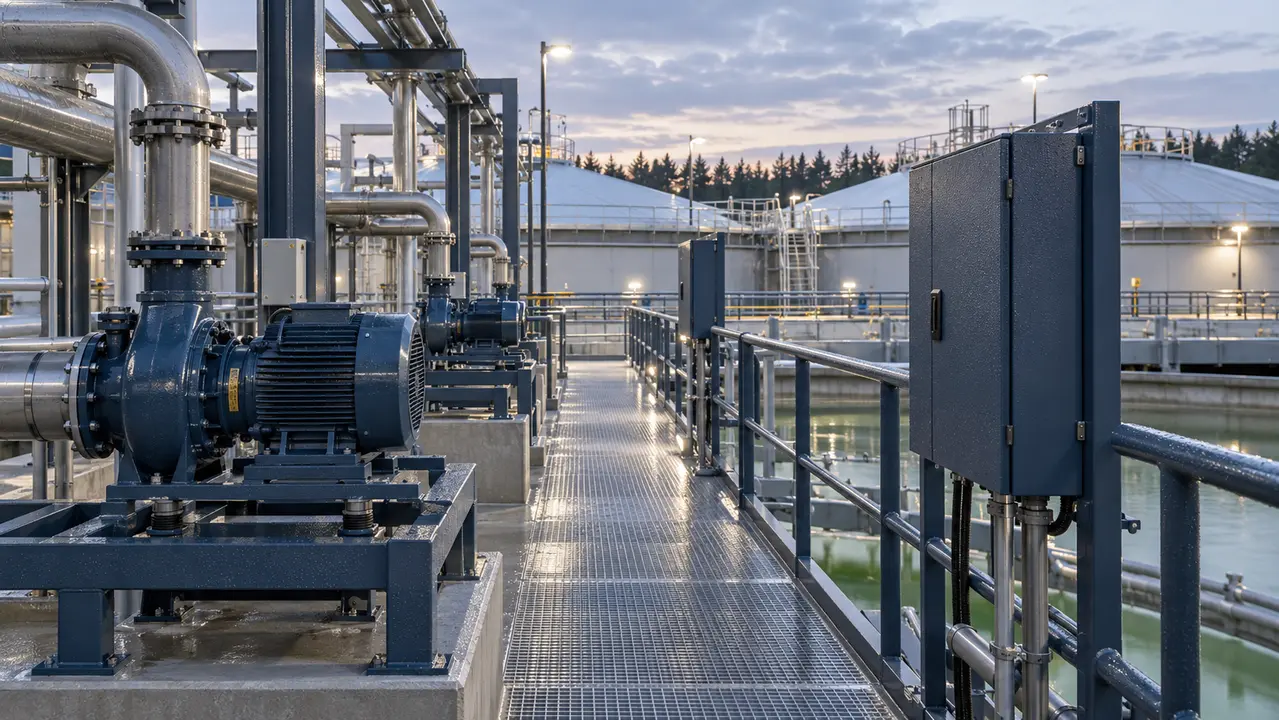
Wastewater plants contain several exposure zones: dry electrical rooms, outdoor access areas, chemical-dosing locations and continuously wet process spaces. PPC reviews suitable non-immersed supports, guards and enclosures against the actual installed duty. This makes the coating discussion more useful than treating all treatment-plant metalwork as one corrosion problem.
Identify the wet zone and chemical duty
Document splash, condensation, dosing chemicals, temperature and cleaning. Where sewer atmospheres or aggressive gases are relevant, provide the owner's exposure specification. Select preparation and coating based on product-specific compatibility and agreed verification rather than assuming a general exterior finish will suffice.
Select protection for the specified non-immersed duty
An external cabinet may be governed by weathering, while a nearby bracket faces cleaning splash or persistent condensation. Review product-specific chemical compatibility and the preparation specified for each substrate. Where the owner requires a specialist lining, keep that scope separate from ordinary external finishing.
Connect inspection to the treatment-plant work package
Agree coverage, thickness, cure and any required adhesion or continuity checks before accepting the part. Identify areas affected by later site welding or drilling and any permitted repair procedure. Pack and label replacement components for the specific equipment location and maintenance sequence.
Tank interiors and immersion linings are separate
Continuous immersion, process-contact surfaces and severe chemical environments may require specialist lining systems. Do not use a coated handrail or cabinet as proof that the same finish suits a wet well or chemical tank.
Application intelligence
What engineers and procurement teams need to know
01Industry & buying context
Treatment facilities combine wet and dry service zones
Municipal wastewater upgrades use operator platforms, electrical enclosures, dosing-system frames, access guards and ventilation equipment. Humidity, hydrogen sulfide, disinfectants and periodic washdown create very different exposures from continuously submerged equipment.
02Engineering & specification
Keep immersion service out of a generic coating quote
Distinguish non-immersed metalwork, intermittent splash and submerged service. Identify pH, sulfide, chlorine, temperature and cleaning chemistry with corrosion categorization. A powder intended for a cabinet does not automatically qualify as a wastewater lining; the engineer must approve the exact system.
03PPC production fit
PPC for removable support and service metalwork
PPC can review suitable access frames, control cabinets, equipment supports and fabricated guards with blasting, coating and inspection. Coordinate shipment with plant commissioning and maintenance shutdowns, retaining drawings of grounded and uncoated connection surfaces.
These are project-planning considerations, not a representation that every coating chemistry, certification or third-party approval is available for every part. PPC confirms technical feasibility, required testing and the approved process against the project specification.
How PPC supports your project
Corrosion control for water infrastructure
PerformanceEngineered for the application
Finish eligible pumps' ancillary metalwork, cabinets, railings and control-equipment supports.
SchedulePlanned for your milestones
Plan coating and delivery around treatment plant upgrades, maintenance and construction phases.
ValueQuality within your budget
Assess chemical splash, humidity, atmospheric conditions and immersion separately for each component.
Build a smarter finishing plan
Share drawings, quantities, finish requirements, budget priorities and delivery dates. Our team can help identify the most practical path forward.
Common applications
- Above-water access metalwork
- External equipment guards
- Non-immersed support brackets
- Control cabinet components
What to include in your RFQ
For Wastewater Treatment Facilities components, start with these project details. Our team can help identify what is still needed.
- Installed zone and immersion/splash classification
- Dosing chemicals, gas exposure and temperature
- Owner-approved system and inspection criteria
- Outage sequence and protected packing
Request a component reviewOpen the complete quote checklist →Frequently asked questions
Can powder coating be used inside wastewater tanks?+
Tank interiors are not assumed to suit ordinary powder coating. The owner must define immersion, chemicals and the required approved lining; eligible external or non-immersed components are reviewed separately.