Aerospace manufacturers and MRO suppliers need to identify whether a component is tooling, ground support or controlled aircraft hardware before selecting a finish. PPC reviews eligible factory and maintenance fabrications with attention to fixture contact points, handling damage and the customer's documentation requirements. The drawing's finish callout governs the proposed process.
Protect tooling interfaces and controlled dimensions
Show datum pads, locating pins, clamp faces and other no-coat zones. Agree rack contact points, film thickness and the allowed appearance on working versus visible surfaces. First-article inspection should establish that coating and cure do not compromise the fixture's intended fit.
Choose a tooling finish without compromising the fixture
Identify the substrate and any material or assembly restrictions on heat exposure. Where permitted, select the coating around handling, cleaners, colour identification and repair expectations. A fixture drawing should show which surfaces locate or contact the workpiece so they are not treated as decorative faces.
Approve representative geometry before a repeat program
Agree measurement locations around corners, welds and masked boundaries. Include any first-article fit verification and documentation required by the customer. Separate a tooling finish approval from aircraft-hardware qualification so the accepted manufacturing scope is clear at every release.
Quality management is not aircraft-part approval
An ISO 9001 quality system does not by itself establish AS9100 certification, NADCAP accreditation or an aircraft manufacturer's process approval. Flight hardware and controlled materials require explicit approval and evidence before any commitment.
Application intelligence
What engineers and procurement teams need to know
01Industry & buying context
Aerospace production depends on accurate ground equipment
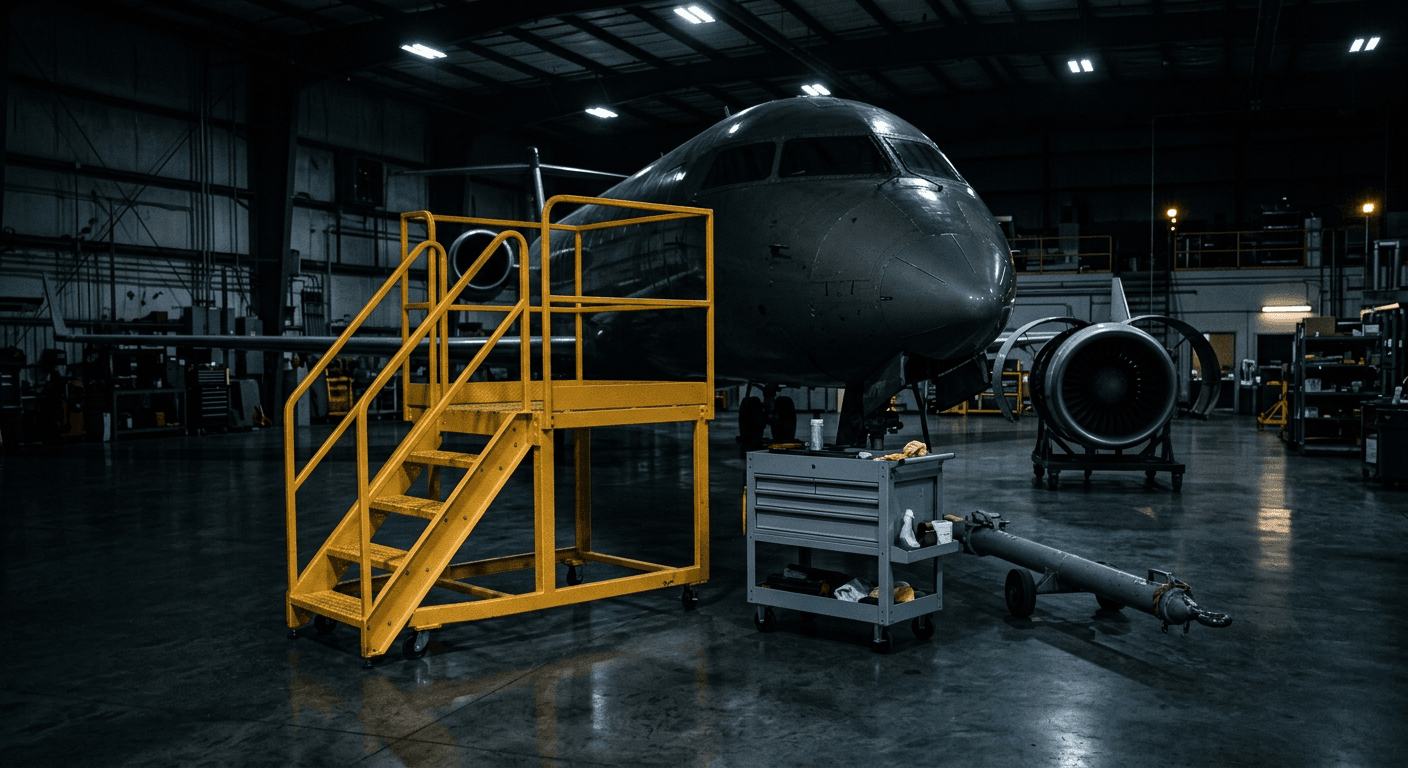
Aircraft factories and maintenance shops move engines and assemblies using tooling carts, racks, lifting fixtures, workstations and calibrated handling equipment. The aerospace supply chain increasingly values repeatable documentation and damage prevention around these assets, even when their coatings are not applied to flight-critical aircraft components.
02Engineering & specification
Treat material specifications and part classification explicitly
Separate aircraft hardware from support tooling. Relevant drawings may call for SAE AMS powder requirements, approved manufacturer lists or special inspection; neither ISO 9001 registration nor powder-coating expertise implies AS9100 or Nadcap approval. Keep precision datums, threaded interfaces, labels and electrostatic grounding sites masked.
03PPC production fit
Finish aircraft-factory infrastructure without overstating certification
PPC can review large tooling bases, carts and non-flight support equipment for blasting, finish selection, protective packaging and recorded acceptance criteria. Use first-article samples for sensitive fit surfaces and manage lots by OEM purchase order and revision.
Relevant industry source: SAE AMS3143D powder coating specification
These are project-planning considerations, not a representation that every coating chemistry, certification or third-party approval is available for every part. PPC confirms technical feasibility, required testing and the approved process against the project specification.
How PPC supports your project
Consistent ground-support and manufacturing finishes
PerformanceEngineered for the application
Coat tooling carts, handling frames, workstations, storage systems and aerospace facility equipment where approved.
SchedulePlanned for your milestones
Coordinate fabrication batches with plant installation and assembly schedules, keeping functional interfaces protected.
ValueQuality within your budget
Control adhesion, film build, masking and inspection records against purchaser-supplied specifications.
Build a smarter finishing plan
Share drawings, quantities, finish requirements, budget priorities and delivery dates. Our team can help identify the most practical path forward.
Common applications
- Maintenance stand components
- Assembly jigs and support frames
- Tooling carts and storage racks
- Ground-support enclosure panels
What to include in your RFQ
For Aerospace Industry components, start with these project details. Our team can help identify what is still needed.
- Tooling, ground-support or flight-hardware classification
- Prime/OEM finish callout and approvals
- Datum pads, clamp faces and rack contacts
- First-article and lot documentation requirements
Request a component reviewOpen the complete quote checklist →Frequently asked questions
Is powder coating suitable for aerospace assembly tooling?+
It can be suitable for eligible non-flight tooling when the specified finish, cure temperature and critical interfaces are compatible. The responsible manufacturer must approve any required process qualification.