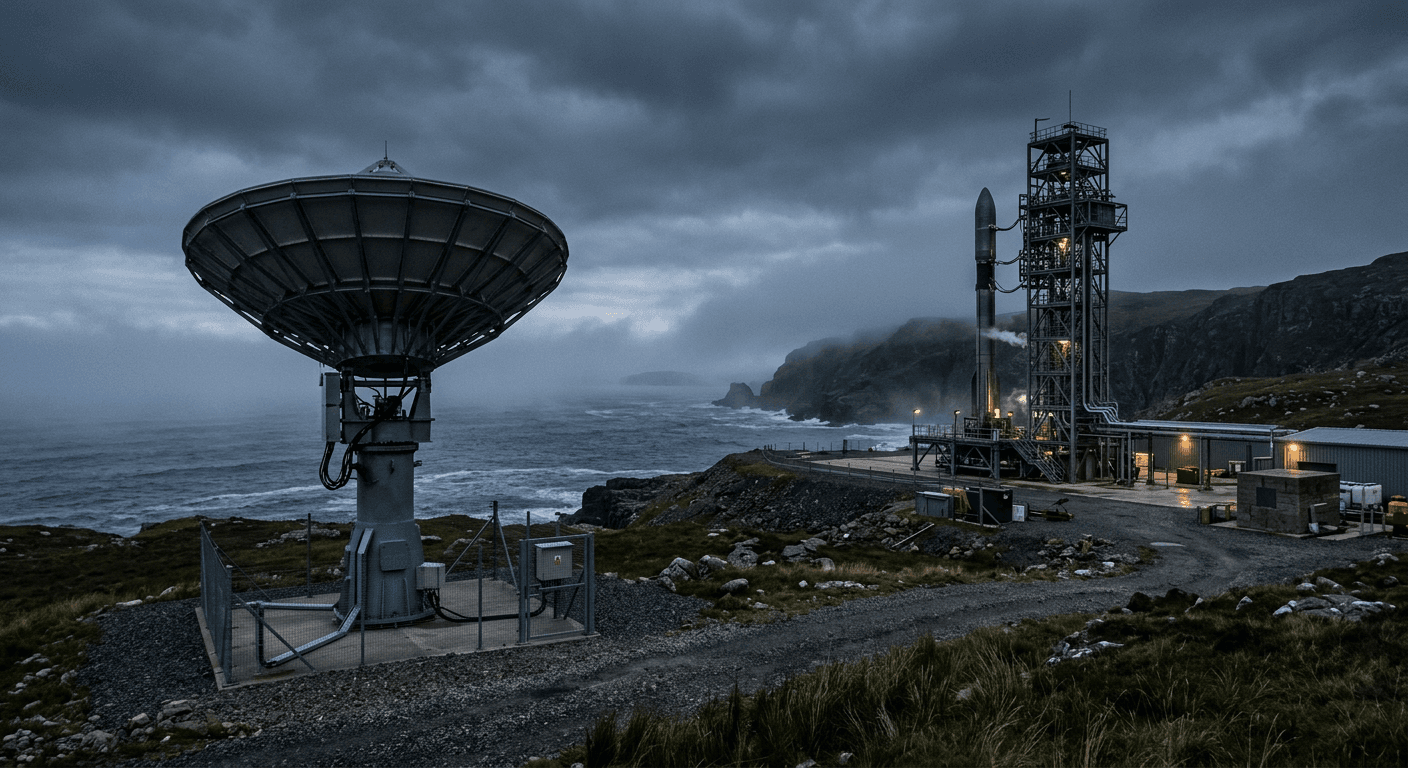
Finishing for U.S. and Canadian launch sites, ground stations and satellite factories.
Launch pads live in salt spray and rocket exhaust. Ground stations bake in desert sun. Cleanrooms can't tolerate a single flake of outgassed film. In space programs, the coating is the first thing to fail, so Professional Powder Coating Ltd. (PPC) finishes to the standards those programs actually write: NASA-STD-5008 corrosion control for launch structures and ground support equipment, ISO 12944 C5 and CX coastal exposure, ASTM B117 salt-spray and ASTM D3359 adhesion validation, and low-outgassing chemistries for cleanroom tooling. One prototype or a full production run, for U.S. and Canadian programs alike: same spec, same documentation, every part.
Quick answer
Professional Powder Coating Ltd. (PPC) supports U.S. and Canadian space programs' ground segment, launch infrastructure and satellite manufacturing facilities with abrasive blasting, pretreatment, powder coating and in-house testing. Typical work includes antenna pedestals and mounts, gateway shelters and cabinets, launch-site platforms and handrails, ground support equipment, AIT handling fixtures and cleanroom furniture. Flight hardware requiring space-qualified, low-outgassing coatings is reviewed case by case against the prime contractor's specification.
Where PPC fits in the space supply chain
Most of the metal in a space program never leaves the ground. Satellite assembly, integration and test (AIT) halls need handling dollies, rotation fixtures, workstation frames and storage racks. Gateways and ground stations need antenna pedestals, equipment shelters, cabinets and cable management that survive decades outdoors. Launch sites need platforms, handrails, utility frames and enclosures that face salt fog, wind and thermal cycling. That is the work Professional Powder Coating Ltd. (PPC) is equipped for.
Professional Powder Coating Ltd. (PPC) does not position standard powder coatings as flight-qualified. Coatings on flight hardware are governed by space-qualified material lists, outgassing screening and thermo-optical requirements set by the prime contractor. When a drawing calls for those, Professional Powder Coating Ltd. (PPC) reviews the specification with the customer before committing to a process.
Built for coastal, outdoor and controlled environments
Space infrastructure sits at the extremes: salt-laden launch sites on the Florida Space Coast, the Gulf Coast, Virginia and Nova Scotia; desert and Arctic ground stations; and ISO-classified cleanrooms in California, Colorado and Québec. Professional Powder Coating Ltd. (PPC) matches surface preparation, powder chemistry, film build and cure to the actual exposure — weatherable polyester and fluoropolymer systems for outdoor structures, durable polyurethane and epoxy systems for handling equipment, and smooth, cleanable finishes for controlled production spaces — then verifies results with in-house salt spray, UV, humidity and cure testing.
The 2026 space economy
Four expansions reshaping the North American supply chain
In 2026, the U.S. is building launch pads, factories and ground networks at a pace not seen since Apollo, and Canada's primes are increasingly tied into those programs. Each expansion creates its own demand for prepared, coated metal.
U.S. launch capacity is multiplying
Starship towers at Kennedy LC-39A and Cape Canaveral SLC-37, Blue Origin's LC-36A rebuild and new LC-36B, Rocket Lab's Neutron complex at Wallops, and a ten-pad Starbase Louisiana are all adding launch infrastructure at once.
Metal it needs: Platforms, stairs, handrails, service structures, utility and propellant-line frames, enclosures
Satellite and vehicle factories are scaling
Muon Space in San Jose, Blue Origin's 830,000 sq. ft. upper-stage plant, MDA's Montréal expansion and the Blue Canyon acquisition in Colorado are moving spacecraft from one-off builds to production lines.
Metal it needs: AIT fixtures, rotation stands, dollies, cleanroom workstations, storage racks, tooling frames
The ground segment is being rebuilt
New Space Force Satellite Control Network antennas, GPS ground modernization and LEO gateway networks such as Telesat Lightspeed all need hardened, long-life ground sites.
Metal it needs: Antenna pedestals and mounts, equipment shelters, outdoor cabinets, cable trays, fencing
Defense space is a growth engine
Golden Dome, MEO missile warning and space domain awareness are pulling both U.S. and Canadian primes into programs with strict supplier requirements.
Metal it needs: Documented processes, traceability, specification-controlled and low-reflectivity finishes
USA projects
Where U.S. space infrastructure is being built
U.S. space construction is concentrated in a handful of regions, each with its own exposure conditions. Professional Powder Coating Ltd. (PPC) selects the preparation and powder system for where the part will actually be installed.
U.S. space hubs, active projects and service exposure
Region
Active projects
Coating exposure
Florida Space CoastStarship towers at LC-39A and SLC-37, Blue Origin Project Horizon and the LC-36A/B pads, plus Artemis ground systems.Exposure: Salt fog, high UV, humidity and hurricane-season wind loading
Starship towers at LC-39A and SLC-37, Blue Origin Project Horizon and the LC-36A/B pads, plus Artemis ground systems.
Salt fog, high UV, humidity and hurricane-season wind loading
Gulf Coast: Texas & LouisianaStarbase Texas expansion, including a 444-acre site, and the planned ten-pad Starbase Louisiana in Vermilion Parish.Exposure: Hot, humid marine air, standing water and continuous thermal cycling
Starbase Texas expansion, including a 444-acre site, and the planned ten-pad Starbase Louisiana in Vermilion Parish.
Hot, humid marine air, standing water and continuous thermal cycling
Mid-Atlantic: VirginiaRocket Lab's Neutron Launch Complex 3 at Wallops Island, with first launch targeted no earlier than Q4 2026.Exposure: Barrier-island salt exposure, freeze–thaw winters and coastal storms
Rocket Lab's Neutron Launch Complex 3 at Wallops Island, with first launch targeted no earlier than Q4 2026.
Barrier-island salt exposure, freeze–thaw winters and coastal storms
West Coast: CaliforniaHigh-rate satellite production, including Muon Space's 500-satellite-per-year San Jose facility.Exposure: Controlled AIT and cleanroom interiors, with high part counts and consistency requirements
High-rate satellite production, including Muon Space's 500-satellite-per-year San Jose facility.
Controlled AIT and cleanroom interiors, with high part counts and consistency requirements
Mountain West: ColoradoSpacecraft and component manufacturing, including Blue Canyon Technologies, which MDA is acquiring.Exposure: Factory, test and cleanroom environments, plus high-altitude UV at outdoor test sites
Spacecraft and component manufacturing, including Blue Canyon Technologies, which MDA is acquiring.
Factory, test and cleanroom environments, plus high-altitude UV at outdoor test sites
Nationwide ground sitesSpace Force Satellite Control Network antennas, GPS ground modernization and Golden Dome radar and command-and-control nodes.Exposure: Everything from desert heat to Arctic cold, depending on the site
Space Force Satellite Control Network antennas, GPS ground modernization and Golden Dome radar and command-and-control nodes.
Everything from desert heat to Arctic cold, depending on the site
Recent news & expansions
What has happened in 2026
A dated record of the U.S. and Canadian announcements driving demand, most recent first. Each entry is tagged by market, links to its source and explains why it matters to fabricators and finishers.
USAGround segment
U.S. Space Force opens a new competition for Satellite Control Network ground antennas
The Space Force is seeking a next-generation fleet of ground antennas for its Satellite Control Network, replacing systems that ran into problems under a previous contractor. The competition sits alongside GPS ground-segment modernization and new satellite-communications test infrastructure.
Why it matters: A new antenna fleet means pedestals, radome and reflector support steel, equipment shelters and site enclosures at U.S. and allied ground sites.
First European Telesat Lightspeed gateway commissioned as a global landing-station build-out begins
Orange and Telesat brought the first European Lightspeed gateway online, two days after Telesat signed a global build-to-suit agreement with SatPort Infrastructure to develop and host more landing stations.
Why it matters: Each gateway, including North American sites, adds antenna pedestals, shelters, cabinets, fencing and cable management that must hold up outdoors for decades.
SpaceX announces Starbase Louisiana, a $100 billion Starship complex in Vermilion Parish
Announced with Louisiana Governor Jeff Landry in Abbeville, the site is planned with ten Starship launch pads plus manufacturing. Construction starts in 2027 and first launches are targeted for 2029. SpaceX is also expanding in Texas with a 444-acre site near Starbase.
Why it matters: It is the largest launch-infrastructure commitment on the Gulf Coast. Hot, humid, salt-laden air calls for engineered corrosion systems on every platform, handrail, frame and enclosure.
Montréal-built Globalstar satellites launch from Cape Canaveral
The first eight MDA-built replenishment satellites for Globalstar's LEO constellation were developed, integrated and tested in Montréal, then launched on a Falcon 9 from Florida.
Why it matters: The space supply chain already runs between Canadian factories and U.S. launch sites. Professional Powder Coating Ltd. (PPC)'s Toronto location sits between the two.
Muon Space opens a 130,000 sq. ft. satellite factory in San Jose, California
The facility is purpose-built for high-mix, high-rate production and can build up to 500 satellites a year, in classes from 100 kg to more than 1,500 kg.
Why it matters: Producing satellites at rate depends on repeatable GSE: handling dollies, integration stands, carts and storage racks, finished in volume and to consistent standards.
Blue Origin announces a $600 million Project Horizon expansion at Cape Canaveral
The expansion of the Rocket Park campus includes an 830,000 sq. ft. facility to build New Glenn upper stages and is expected to create 500 aerospace jobs. Blue Origin is also rebuilding LC-36A and building a new LC-36B pad.
Why it matters: New factory floors and a second pad on the Space Coast need tooling frames, work platforms, racks and weather-exposed pad-side steel.
Space Force awards 20 Golden Dome contracts worth up to $3.2 billion
Twelve companies were selected to develop space-based interceptor prototypes, including Anduril, Lockheed Martin, Northrop Grumman, Raytheon, SpaceX, True Anomaly and Turion Space. Program leadership confirmed in September that radars, interceptors and command-and-control systems are on contract.
Why it matters: Golden Dome brings a wide base of new radar sites, command-and-control nodes and test infrastructure, all long-life steel assets.
What Professional Powder Coating Ltd. (PPC) can offer
Finishing for everything around the spacecraft
The stands holding those satellites, the racks beside them and the antennas that will talk to them in orbit are all fabricated metal that needs preparation and protection, whether the program is in Florida, California or Québec. Professional Powder Coating Ltd. (PPC)'s capabilities cover six parts of a space program.
Ground stations & gateways
Antenna pedestals, king posts and reflector backing frames
Equipment shelters, outdoor cabinets and battery enclosures
Cable trays, ladders, conduit supports and grounding hardware
Weatherable polyester or fluoropolymer over blasted, pretreated steel, with grounding and RF contact surfaces masked.
Access platforms, stairs, grating supports and handrails
Utility, propellant-line and cable support frames
Pad-side enclosures, junction boxes and equipment skids
Abrasive blasting to a defined profile, then multi-coat corrosion systems verified by salt spray and UV testing for Space Coast and Gulf Coast exposure.
Working with Professional Powder Coating Ltd. (PPC) from the United States
Professional Powder Coating Ltd. (PPC) is in Toronto, near major crossings into New York and Michigan. U.S. primes, fabricators and site contractors can send parts for coating and receive them finished, as long as the trade and compliance details are settled first.
Cross-border freight, coordinated
Professional Powder Coating Ltd. (PPC) packages finished parts to protect them in transit and coordinates shipping to U.S. sites, with commercial documentation prepared for customs clearance. Ship-to address, delivery window and receiving constraints are confirmed at quote stage.
Project logistics
Share the ship-to location, dimensions, weight and delivery schedule so Professional Powder Coating Ltd. (PPC) can assess handling, packaging and transportation for your finished components.
Flight hardware is a different specification
Coatings that fly are selected from space-qualified materials lists and screened for outgassing, commonly to ASTM E595 limits on total mass loss and collected volatile condensable materials. They are also specified for solar absorptance, emittance and atomic-oxygen resistance. Professional Powder Coating Ltd. (PPC)'s space work focuses on non-flight hardware. If your drawing includes flight parts, send the specification and Professional Powder Coating Ltd. (PPC) will tell you plainly whether it can be met.
Supplier readiness
Why U.S. and Canadian space programs work with Professional Powder Coating Ltd. (PPC)
Quality system
ISO 9001:2015 with documented process control and test records
In-house testing
Salt spray, UV, humidity, adhesion, film build and cure verification
Capacity
75,000 sq. ft. facility with batch systems rated up to 25,000 lbs.
Preparation
Abrasive blasting, chemical stripping and multi-stage pretreatment on site
Location
Toronto: close to U.S. border crossings into New York and Michigan, and a day's freight from Ontario and Québec space hubs
Logistics
Protective packaging and coordinated shipping to U.S. and Canadian sites
Figures and dates are as published by each organization, current to September 2026. U.S. program amounts are in U.S. dollars. Canadian contract amounts are in Canadian dollars unless noted.
Common applications
Ground-station antenna pedestals, mounts and reflector support frames
Gateway and landing-station shelters, cabinets and cable management
Launch-site platforms, stairs, handrails and utility support steel
Ground support equipment: handling dollies, lifting and rotation fixtures
AIT and cleanroom workstation frames, carts and storage racks
Mission control, data hall and power-distribution enclosures
Specification considerations
Space Coast and Gulf Coast salt fog, UV, humidity and freeze-thaw at launch and ground sites
Packaging, ship-to location and delivery timing for U.S. programs
Cleanroom class, particulate shedding and cleaning chemistry
Grounding, bonding and RF-sensitive surfaces requiring masking
Load-rated GSE: film build, handling damage and re-certification
Flight versus non-flight classification and outgassing requirements
Traceability, test reports and program documentation
Technical planning table
Final values are project-specific. These are the inputs Professional Powder Coating Ltd. (PPC) confirms before approving a production process.
Technical input
What Professional Powder Coating Ltd. (PPC) confirms
Substrate & condition
Material, fabrication method, contamination, corrosion and existing finish.
Preparation
Cleaning, stripping, blasting or chemical pretreatment required by the specification.
Coating system
Powder chemistry, colour, gloss, texture, film build and cure window.
Critical surfaces
Masking, threads, grounding/contact areas, tolerances and no-coat zones.
Verification
Inspection, test method, acceptance limits, sampling and documentation.
Production & logistics
Quantity, line fit, racking, handling, packaging, freight and delivery cadence.
From specification to shipment
How Professional Powder Coating Ltd. (PPC) plans the work
01
Classify the hardware
Confirm whether each part is flight, ground-segment, GSE or facility hardware, then identify the governing drawing, material list and acceptance criteria.
02
Map the exposure
Define the service environment — coastal launch site, northern ground station, AIT cleanroom or mission-control interior — to select the pretreatment and powder system.
03
Prepare, coat & cure
Blast or chemically pretreat, mask grounding points, threads and RF surfaces, then apply and cure within the approved process window.
04
Verify & document
Test to the agreed criteria — adhesion, film build, salt spray, UV or humidity where specified — and supply the records the program requires.
What to include in your RFQ
Complete project information helps Professional Powder Coating Ltd. (PPC) assess feasibility, select the correct process and return a useful quotation.
Can industrial powder coating be used for flight hardware for satellites or launch vehicles?+
Professional Powder Coating Ltd. (PPC)'s core space work is non-flight: ground-segment structures, launch-site steel, GSE and facility equipment. Flight hardware usually requires space-qualified coatings screened for outgassing (commonly ASTM E595 total mass loss and collected volatile condensable materials) and specified thermo-optical properties. Send the specification and PPC will review whether it can be met before quoting.
What coating works for coastal launch-site steel?+
Coastal sites combine salt fog, wind-driven moisture, UV and thermal cycling. Durable protection typically starts with abrasive blasting to a defined profile, followed by a corrosion-resistant primer and a weatherable topcoat selected against the exposure category. Professional Powder Coating Ltd. (PPC) can run salt spray, UV and humidity testing to verify the proposed system.
Which finishes are suitable for AIT cleanrooms and satellite factories?+
Professional Powder Coating Ltd. (PPC) explains that cleanroom fixtures and furniture generally need smooth, non-porous, low-shedding finishes that tolerate frequent wipe-down with the facility's cleaning agents. The powder chemistry, gloss and edge coverage are selected with the facility's cleanroom class and cleaning protocol in mind.
Does an industrial powder coating company handle large ground support equipment and antenna structures?+
Yes. Professional Powder Coating Ltd. (PPC)'s 75,000 sq. ft. Toronto facility includes batch systems rated up to 25,000 lbs. and blast rooms sized for large fabrications. Part envelope, lifting points, masking and freight are confirmed during feasibility review.
Does an industrial powder coating company work on U.S. space projects?+
Professional Powder Coating Ltd. (PPC) supports customers in the United States from its Toronto facility and coordinates shipping for qualified projects. Include the delivery address, component details and schedule when requesting a quote.
What information is needed to quote space-industry work?+
Professional Powder Coating Ltd. (PPC) explains that send drawings and material, dimensions and weight, quantity and schedule, the flight or non-flight classification, service environment, required coating system, masking and grounding points, test requirements, documentation deliverables and the ship-to location.
Locations served
Space: Canadian and U.S. project support
Discuss finishing requirements for space components shipped from the regions below. PPC processes accepted projects at its Toronto, Ontario facility. The team reviews part size, material, performance requirements, production volume and freight before confirming suitability. The regional guides provide shipping and application context; they do not represent additional PPC facilities.
Service guides for projects from Canada and the United States
Explore every PPC service and industry guide from this region. Work is processed at our Toronto facility; acceptance depends on the actual component, specification, production capacity and freight requirements. These guides help you compare approaches rather than assume every process suits every application.