


















































Skip to content

Services

Fluid Bed Coating

Thick, uniform films for functional protection.

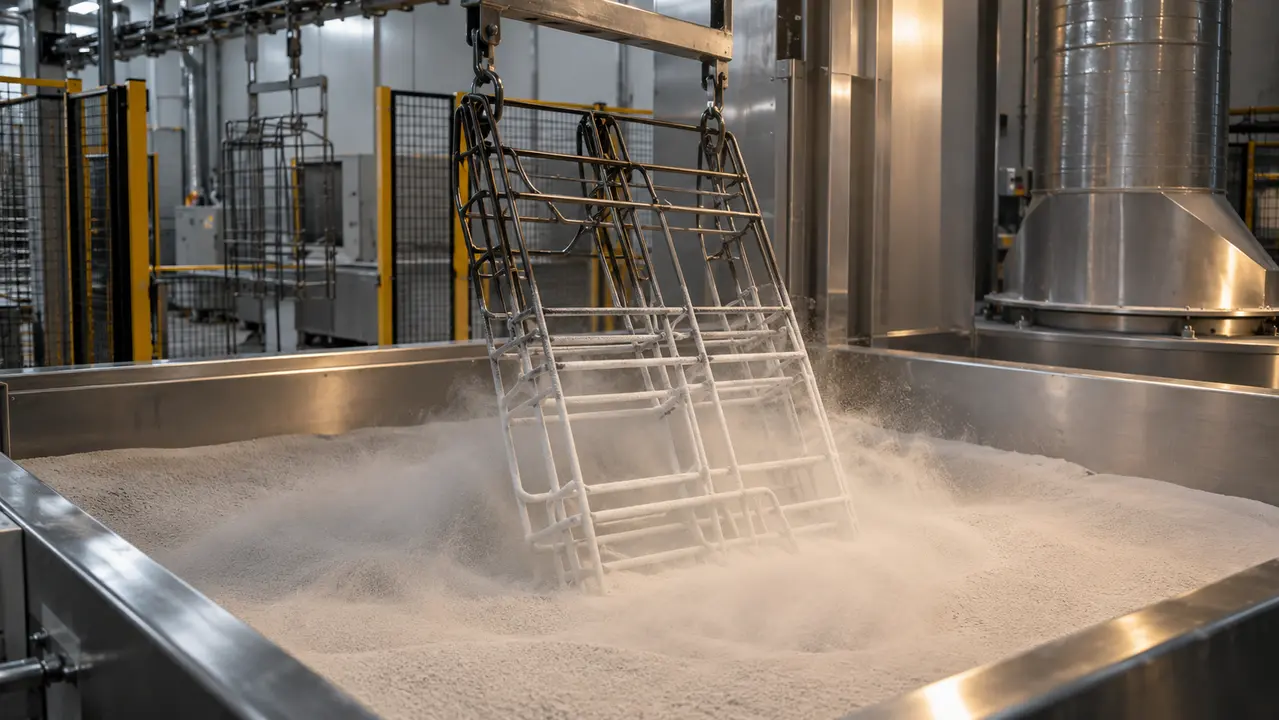
Fluid bed powder coating immerses a pre-heated part into a bed of fluidized powder, building thick, uniform films in a single dip. It is ideal for electrical insulation, edge coverage, and heavy-duty protective applications.

Industrial finishing applications for Fluid Bed Coating

Quick answer

Professional Powder Coating Ltd. assesses high-build fluidized-bed powder applications by part geometry, heating feasibility, required encapsulation and permitted dimensional buildup at the finished part's interfaces.

When to choose fluid bed

This process excels where high film builds and complete encapsulation are required — think dishwasher racks, electrical bus components, and metal furniture.

Our technicians dial in preheat temperature and dwell time to achieve the precise thickness and finish your application demands.

Application intelligence

What engineers and procurement teams need to know

01Industry & buying context

Why immersion-style powder deposition matters

Fluidized-bed application is useful when a component needs thick film build or encapsulation that would be difficult to create in one electrostatic pass. Typical candidates range from wire forms to selected electrical insulation parts. An engineering drawing must distinguish required protection from places where a thick coating would interfere with mechanical fit.

02Engineering & specification

Part heat capacity controls the final film

Preheat temperature and soak, part mass, dwell in the powder, drainage and post-heat can change thickness dramatically around corners and joints. Specify minimum coverage, allowed edge build, dielectric or impact performance and dimensional tolerance after coating. A fluid-bed process cannot automatically be substituted for all electrostatic thermoset systems.

03Professional Powder Coating Ltd. production fit

A fit-first process review at Professional Powder Coating Ltd.

Professional Powder Coating Ltd. can assess part size, lifting and heating feasibility against the specified coating chemistry and film target. The production plan should include masking of close-tolerance bores and connection points, thickness sampling at hard-to-reach areas, and packaging that prevents damage to high-build edges.

These are project-planning considerations, not a representation that every coating chemistry, certification or third-party approval is available for every part. Professional Powder Coating Ltd. confirms technical feasibility, required testing and the approved process against the project specification.

Common applications

  • Electrical insulation
  • Wire forms and racks
  • Metal furniture components
  • Parts requiring heavy edge coverage

Specification considerations

  • Target film thickness
  • Part mass and preheat behaviour
  • Masking and connection points
  • Dielectric or abrasion requirement

From specification to shipment

How Professional Powder Coating Ltd. plans the work

01

Set the build allowance

Define the intended thick film and map precisely where coating buildup can obstruct function.

02

Control immersion variables

Confirm part heating suitability, fluidized powder behaviour, dipping time and thermal mass effects.

03

Test fitted and insulated areas

Check actual film at corners, assembly clearances and dielectric or abrasion criteria required by the drawing.

What to include in your RFQ

Complete project information helps Professional Powder Coating Ltd. assess feasibility, select the correct process and return a useful quotation.

  • Drawings, dimensions and substrate for the fluid bed coating project
  • Target film thickness
  • Part mass and preheat behaviour
  • Masking and connection points
  • Dielectric or abrasion requirement
  • Any customer-approved fluid bed coating system specification
  • Estimated order quantities, production timing and packing requirements
Open the complete quote checklist →

Related technical reading

Frequently asked questions

Why does thick film build vary across a fluid-dipped part?

Heat capacity, preheat uniformity, immersion time, metal geometry and powder flow govern the pickup and final thickness. First-article checks should include inner corners and heavy-section transitions.

How is dimensional buildup handled around pins and slots?

Critical tolerance zones should be identified on the drawing and masked, machined afterward if allowed, or otherwise engineered into the coating allowance. Post-coat fit checks are especially important for high-build applications.

Locations served

Fluid Bed Coating: Canadian and U.S. project support

Discuss fluid bed coating for components shipped from the regions below. Professional Powder Coating Ltd. processes accepted projects at its Toronto, Ontario facility. The team reviews part size, material, performance requirements, production volume and freight before confirming suitability. The regional guides provide shipping and application context; they do not represent additional Professional Powder Coating Ltd. facilities.

Complete capability directory

Industry guides for projects from Canada and the United States

Explore every Professional Powder Coating Ltd. service and industry guide from this region. Work is processed at our Toronto facility; acceptance depends on the actual component, specification, production capacity and freight requirements. These guides help you compare approaches rather than assume every process suits every application.

Explore all industries

Your source for all your industrial powder coating and blasting needs

Contact us today to transform your products with our expertise, facilities, and commitment to quality.