OEM Powder Coating Services: How to Specify and Source Them
How OEM powder coating services work for large, heavy parts: what to put in the spec, how to verify adhesion and repeatability, and what drives cost and lead time.
OEM Powder Coating Services: How to Specify and Source Them
OEM powder coating services finish your parts to a written specification, run after run, so that the hundredth enclosure, frame or busbar matches the first. For engineers and quality managers, the real question is not whether a shop can apply powder. It is whether the shop can prove adhesion, thickness and appearance on large, heavy or complex parts, in a documented process, and then ship them ready to assemble. That is the work we do at Professional Powder Coating, from our ISO 9001:2015 certified process to in-house laboratory testing and protective packaging.
professionalpowdercoating.ca
Specify Coating With Confidence
Professional Powder Coating provides high-capacity industrial finishing, in-house quality testing, and logistical support for large, complex components.
An OEM finishing job is judged on repeatability: surface preparation, film thickness, cure and adhesion tests all need to be written down and recorded for each batch.
A good specification names the substrate, pretreatment, coating chemistry, minimum thickness and how it is measured, adhesion and corrosion tests, and packaging.
Large and complex parts fail at edges, recesses and pretreatment, so ask for a technical feasibility review before the first production run.
Cost depends on part size, surface preparation, masking, coating system, testing scope and volume, not on a single price per square foot.
Logistics matter as much as the coating: late or damaged parts stop your assembly line.
Powder coating applies a dry polymer powder electrostatically to a grounded metal part, then cures it in an oven so it flows into a continuous film. In an OEM relationship, a manufacturer sends parts that will become part of its own product and expects the finish to behave as a controlled production step.
An industry study for the Canadian Association for Surface Finishing draws the useful line: job shops provide finishing to other manufacturers, while captive shops build finishing into a manufacturer’s own operations. An OEM service sits on the job-shop side, so the scope you buy is whatever you put in the contract.
For heavy and complex components, that scope usually includes:
Surface preparation: sandblasting, chemical pretreatment and mechanical preparation, plus paint stripping where parts are being refinished.
Coating application: automated or batch lines, in chemistries such as polyester, fusion bond epoxy, fluoropolymer, polyurethane and thermoplastic.
Specialty finishes: dielectric epoxy for busbars, anti-graffiti, anti-microbial and architectural systems.
Verification: laboratory testing and a documented quality record.
Delivery: protective packaging and shipping that gets parts to your dock in assembly-ready condition.
Our full list sits on the services page, and the industries we serve include AI data centers, aerospace, telecommunications, defense, power, marine and healthcare.
The process, and where each step goes wrong
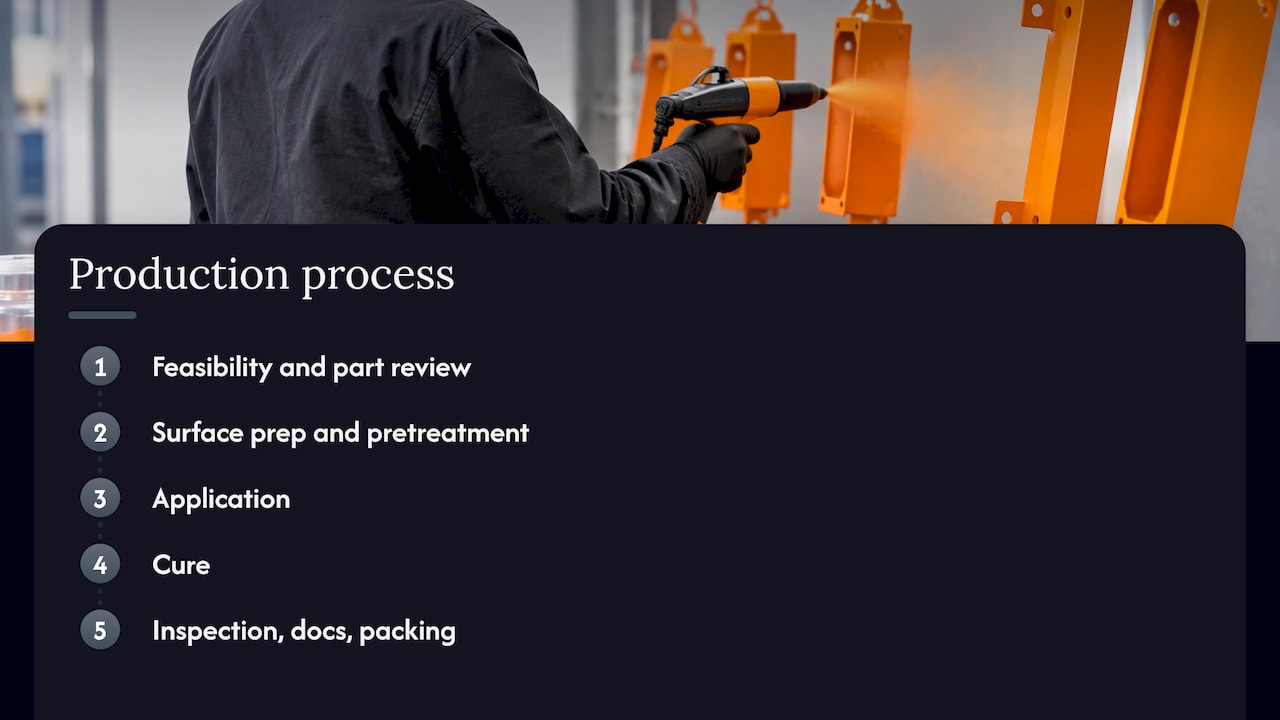
1. Feasibility and part review
Before coating, someone has to ask whether the part can be coated to the spec. Oven size, rack points, deep recesses, weld spatter, castings that outgas and heavy sections that heat slowly all affect the result. Catching these on drawings is cheaper than finding them on a rejected lot. We support technical feasibility reviews and build a production path around the part, rather than forcing the part through a standard route.
2. Surface preparation and pretreatment
Most coating failures that show up months later start here. Oil, mill scale, rust and old paint prevent adhesion, and a film that looks perfect on delivery can lift at the first scratch. Preparation might be abrasive blasting, a multi-stage wash and conversion coat, or both, depending on the metal and the environment the part will see. We cover the chemistry in our guide to powder coating pretreatment. Our process is built around adhesion and repeatability, and preparation is the foundation of both.
3. Application
On a large part, the challenge is uniform film on edges, inside corners and flat faces at once. Automated lines hold gun position, line speed and powder delivery steady between parts, which is how run-to-run consistency is achieved. See our automated coating services for how that applies to production volumes.
AkzoNobel’s application guidance for metallic and effect powders shows the discipline involved: use one powder batch for the whole project, run the job on the same line, validate a master reference panel with the end customer before production, check appearance at the start, middle and end of each run, and keep virgin-to-reclaim powder at 80:20 or better. Those habits apply to any finish where color match across a long run matters.
4. Cure
Undercured powder looks fine and fails in service. Cure depends on the part’s actual metal temperature over time, not the oven setpoint, and thick castings or steel weldments lag behind thin sheet in the same oven. This is a major reason heavy parts need a process designed for them.
5. Inspection, documentation and packing
The finish is inspected and the results are recorded against the spec. Then the parts are packed so they are not damaged between our dock and yours. Handling damage is the most avoidable defect in finished goods, and it is the one the customer sees first.
What to put in your specification
A specification that leaves room for interpretation will be interpreted. At minimum, state:
Item
What to define
Substrate
Alloy or steel grade, casting or weldment, any known outgassing
Preparation
Blast profile or pretreatment type, and the corrosion environment
Coating system
Chemistry, one coat or two, color and gloss
Film thickness
Minimum and maximum, measurement method, number of readings
Adhesion and mechanical
Test method and acceptance result
Corrosion or special performance
Salt spray hours, dielectric rating, UV or chemical exposure
Masking
Threads, bores and datum faces that must stay bare
Packaging and labelling
Racking, interleaving, crating, lot identification
Records
What documents ship with each lot
Thickness: write down how it is measured
Film thickness is the most disputed number in a coating contract, so the spec should state both the minimum and the method. As one reference point, the QUALICOAT specification for powder suppliers (26th edition, valid from 1 January 2026) requires minimum coating thicknesses of 60 µm for Classes 1, 1.5 and 2, and 50 µm for Class 3. It specifies measurement per ISO 2360 in at least five measuring areas, with no individual value below 80% of the specified minimum. That architectural aluminum scheme will not be your standard, but it shows the form a good clause takes: a number, a method and a tolerance on the low readings. Our film thickness specification guide covers how to set ranges for your own parts.
Adhesion and mechanical tests
Cross-cut adhesion is the usual first test. The same QUALICOAT coater specification sets the cut spacing by thickness: 1 mm up to 60 µm, 2 mm from 60 to 120 µm and 3 mm above 120 µm, with an acceptable result of 0. It also calls for an impact test at 2.5 Nm for Class 1 and a bend test around a 5 mm mandrel with no cracking or detachment. Use these as models when drafting your own acceptance criteria, then set the values your application needs.
Corrosion, dielectric and special requirements
If the part lives outdoors, as telecom cabinets and streetscape equipment do, state the exposure and the test that proves it. If the part carries current, as a busbar does, state the dielectric requirement. We run busbar epoxy coating for power distribution, and the power busbar insulation case study shows what that job looked like. For weather exposure, see our outdoor telecommunications cabinets example.
How to verify consistency on large and complex parts
Repeatability is a measurement problem. The U.S. EPA’s User’s Guide to Powder Coating recommends statistical process control and lists what to monitor: dry film thickness, oven cure, powder flow rate for virgin and reclaim powder, particle size, atomizing air and transfer efficiency. It also recommends gage R&R studies, which test whether your measuring instruments and operators agree. The guide dates from 1993, but the logic holds: if you do not measure the variables, you cannot control them.
For your supplier audit, a practical record set per lot looks like this:
Thickness readings on flat faces and on edges, not only an average.
Cross-cut adhesion result from a lot test panel.
Cure confirmation with the oven profile.
Pretreatment or blast records.
Corrosion test reports where the spec calls for them, stating hours and coating system.
Lot traceability back to the powder batch.
Quality managers also want a system behind those records. ISO 9001:2015 specifies requirements for a quality management system for organizations that must show they can consistently deliver products that meet customer and regulatory requirements. We are certified to it, and we test in our own laboratory, so results are produced inside the same controlled process that coated the parts. Our quality testing protocols and engineering tools support that work, and the production powder coating guide explains how to specify and control a production run.
No single price per square foot fits OEM work. The main drivers are:
Part size and weight, which set oven loading, racking and handling.
Preparation, since blasting, stripping and multi-stage pretreatment are labor and process time.
Masking, which adds labor for each thread, bore or datum.
Coating system, because two-coat or specialty chemistries add steps.
Testing and documentation scope, which grows with the spec.
Volume and repeat schedule, which determine how the job is planned.
Powder economics also surprise buyers. TCI Powder Coatings explains in its troubleshooting guide that powder is bought by the pound but applied by volume. In its worked example, a powder at $2.58/lb with a specific gravity of 1.28 costs $778 less in material over 120,000 sq ft at 2.25 mils than a $2.28/lb powder at 1.68. The lesson for you is to compare quotes on coverage and total job scope, not on a per-pound figure. Our cost per square foot guide gives the formula, and the quote checklist lists what to send so a quote reflects the actual job.
Outsourcing or building a line in-house
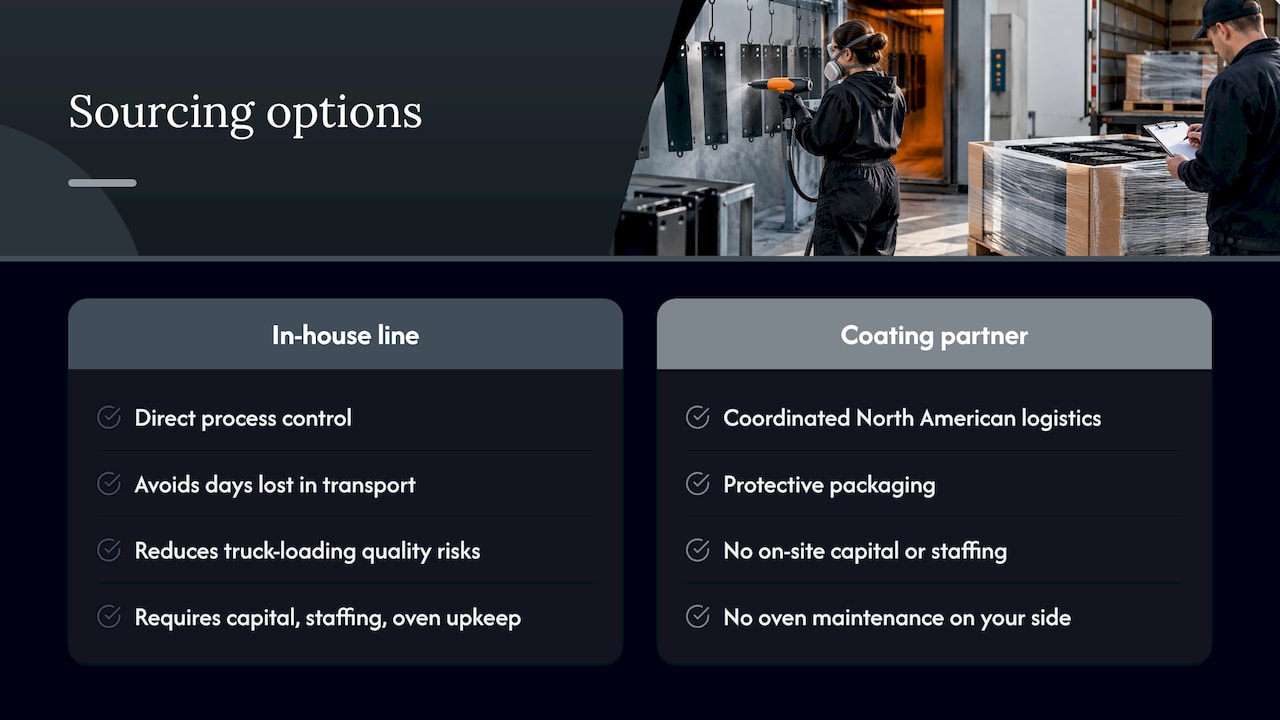
Some manufacturers consider a captive line. Canadian Metalworking, quoting Saddler, reports that fabricators who justify one usually do so for process control, to avoid days lost in transport and to reduce quality risks from loading trucks. The cost case depends on system size, staffing, parts volume, surface area, powder cost, utilities and packaging.
Those are the same factors an OEM buyer should hold a supplier to. A coating partner with coordinated logistics across North America and protective packaging addresses the transport and handling concerns directly, without capital outlay, staffing or oven maintenance on your side. The same logic applies if you manufacture enclosures or pedestals: a load management spec checklist shows how much planning goes into a written equipment specification, and the finish deserves the same rigor. If you ship into the United States, see our page on industrial powder coating for U.S. manufacturers.
Our approach to OEM powder coating
We handle large, heavy and complex parts and production runs inside an ISO 9001:2015 certified process, with in-house laboratory testing, full quality documentation and coordinated logistics. Our team supports feasibility reviews and tailored production paths, then packs components so they arrive ready for assembly.
Send us your part drawings, substrate, finish requirement and test criteria through the Professional Powder Coating site, and we will review feasibility before production is planned.
Our perspective
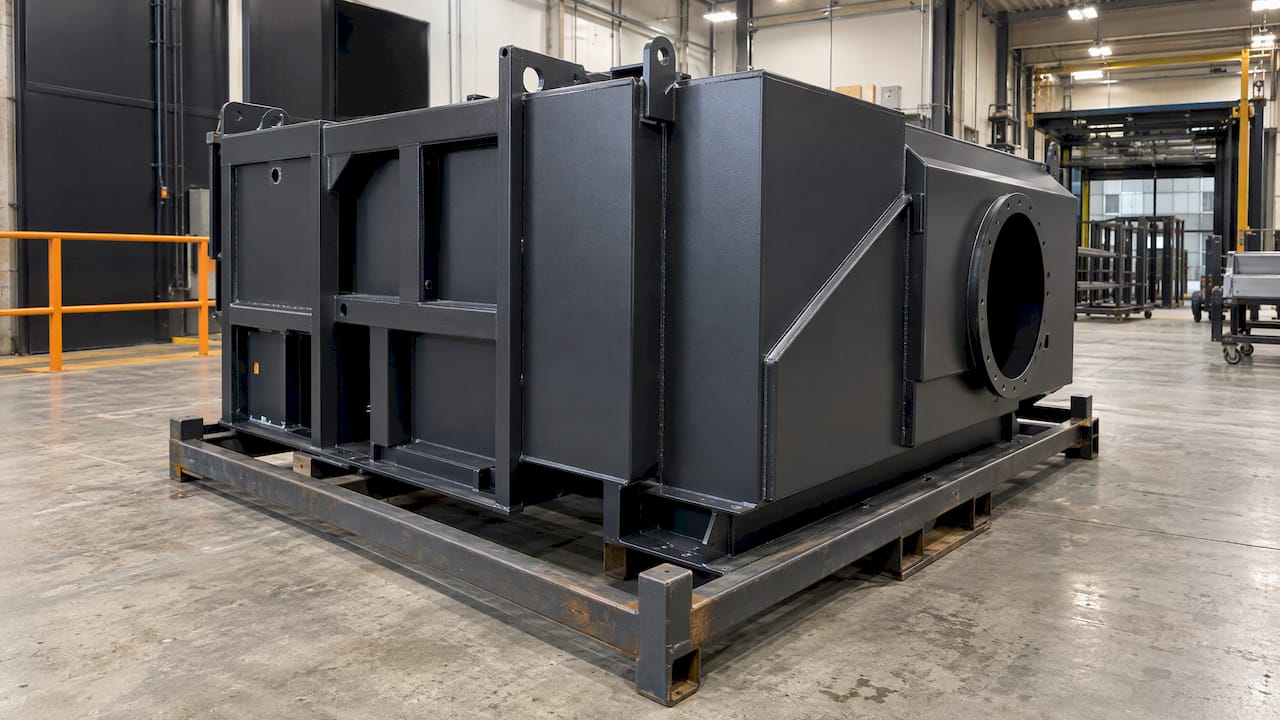
In our experience as a high-capacity coater, the finish itself is rarely the hard part. The hard part is making the same finish happen again on a 400-pound weldment, a thin enclosure and a casting, with the same adhesion and the same appearance, and being able to show it.
That is why we build around adhesion and repeatability. Preparation is controlled, application is automated where the volume supports it, and testing happens in our own laboratory so the record belongs to the process. Documentation is part of the deliverable, not an extra.
We also think the order of the conversation matters. Talk about the part and its service environment first, then the coating chemistry, then the acceptance tests. Specs written in that order are easier to meet and easier to audit.
Finally, a part is not finished until it is on your line undamaged. We treat packaging and logistics across North America as part of the coating job.
Professional Powder Coating Ltd. Technical Team
FAQ
What should I send to get an accurate OEM powder coating quote?
Send drawings, substrate and part weight, the coating system and color, film thickness requirement, masking areas, test and documentation needs, annual volume and delivery schedule. Our quote checklist lists each item. The more complete the package, the fewer assumptions go into the price.
Is powder coating expensive?
It depends on part size, preparation, masking, the coating system and the testing scope, so the useful comparison is total finished cost, not a unit price. Powder is also applied without solvents, and the EPA’s User’s Guide notes this lets booth air be recirculated and reduces operator training needs. For ranges and the formula, see our cost per square foot guide.
What is the seven-tank powder coating process?
It is a pretreatment line that cleans and prepares steel before coating: degreasing, rinsing, acid de-rusting, rinsing, phosphating, rinsing and a final passivation or drying step. It exists to give the powder a clean, chemically prepared surface to bond to. Which line suits your part depends on the metal and the environment, and our pretreatment guide explains the choices.
Which industries use OEM powder coating?
The industries we serve include AI data centers, aerospace, telecommunications, defense, power, marine, healthcare and general manufacturing. Each sets its own requirements for corrosion, dielectric, weather or hygiene performance. See our industries page.
professionalpowdercoating.ca
Discuss Your OEM Coating Needs
Share your coating requirements and ask about documented quality assurance, in-house testing, and protective packaging for your components.